Stress Relieving 190–210°C (374–410°F): Three Levels of Post-Weld Heat Treatment and Temperature Control with Tempilstik®
The term "stress relief" is frequently used as a synonym for PWHT (post-weld heat treatment). In practice, stress relief covers three distinct temperature levels — each with its own technical purpose, applicable conditions, and limitations. They cannot be substituted for one another. Misunderstanding the difference leads either to unnecessary heat treatment (wasted cost) or to skipping required treatment (engineering risk). This article analyses all three levels, with particular focus on the lowest — 190–210°C (374–410°F) — which is often overlooked but has important practical applications in fabrication and maintenance.
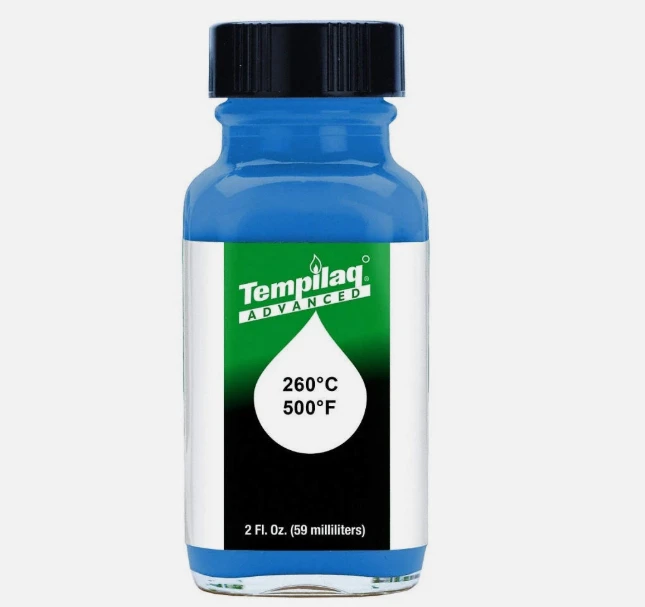
Three Levels of Stress-Relief Heat Treatment
Level 1: Low-Temperature Stress Relief — 190–210°C (374–410°F)
At 190–210°C, the steel's crystal structure does not undergo any significant change — there is no carbon diffusion or recrystallisation. The stress-relief mechanism at this level is primarily relaxation of elastic residual stress: atoms in the crystal lattice receive enough thermal energy to shift slightly, reducing stress levels from near yield strength down to approximately 50–70% of yield strength.
The effect is limited compared with full PWHT — but in many situations this is the maximum achievable level given engineering or practical constraints. Typical soak time: 1–2 hours for carbon steel of light to medium thickness.
Level 2: Intermediate Stress Relief — 300–400°C (572–752°F)
At 300–400°C the relief mechanism includes both plastic flow and microstructural recovery. Residual stress drops more substantially — to roughly 20–30% of yield strength. This level is sometimes used as an inter-pass heat treatment during complex fabrication: after a defined number of weld passes, heating the entire assembly to 300–400°C for 30–60 minutes reduces accumulated stress before the final PWHT.
Level 3: Full PWHT — 580–760°C (1076–1400°F)
This is the full code-compliant post-weld heat treatment per ASME/AWS. At these temperatures, stress relief, HAZ softening, and hydrogen diffusion all occur simultaneously. Residual stress is reduced to below 10–15% of yield strength. For full details see PWHT — Post-Weld Heat Treatment and the Role of Tempilstik®.
| Level | Temperature Range | Residual Stress After | Substitutes for Full PWHT? | Tempilstik® Part No. |
|---|---|---|---|---|
| Low-temperature SR | 190–210°C (374–410°F) | ~50–70% of yield strength remaining | No | #28325 (190°C / 374°F) / #28035 (204°C / 400°F) |
| Intermediate SR | 300–400°C (572–752°F) | ~20–30% of yield strength remaining | No | #28039 (232°C / 450°F) — confirms threshold exceeded |
| Full PWHT | 580–760°C (1076–1400°F) | < 10–15% of yield strength remaining | This is PWHT | #28047 (316°C / 600°F) — spot-check lower bound |
When to Apply Low-Temperature Stress Relief at 190–210°C
The 190–210°C (374–410°F) level is applied in situations where full PWHT is either not technically feasible or not required by the applicable code, but partial stress reduction still delivers a clear engineering benefit:
- In-situ repair welding on equipment in service or too large to move to a furnace — full PWHT is impractical; local heating to 190–210°C is a viable field alternative
- Pre-treatment before hot-dip galvanizing: high residual stress in welded structures can cause liquid metal embrittlement (LME) cracking when the assembly is immersed in the galvanizing bath at ~450°C (842°F). A low-temperature stress relief at 190–210°C before galvanizing significantly reduces this risk
- Low-carbon steel structures not requiring PWHT under the applicable code (P-No.1 below the thickness threshold) but exposed to a stress corrosion cracking (SCC) environment — reducing residual stress improves service life
- After weld overlay or cladding restoration on wear-resistant equipment surfaces where full PWHT is not possible but localised stress reduction in the deposit is beneficial
- Cryogenic-adjacent applications: welds operating at low temperatures where reduced residual stress improves Charpy impact toughness
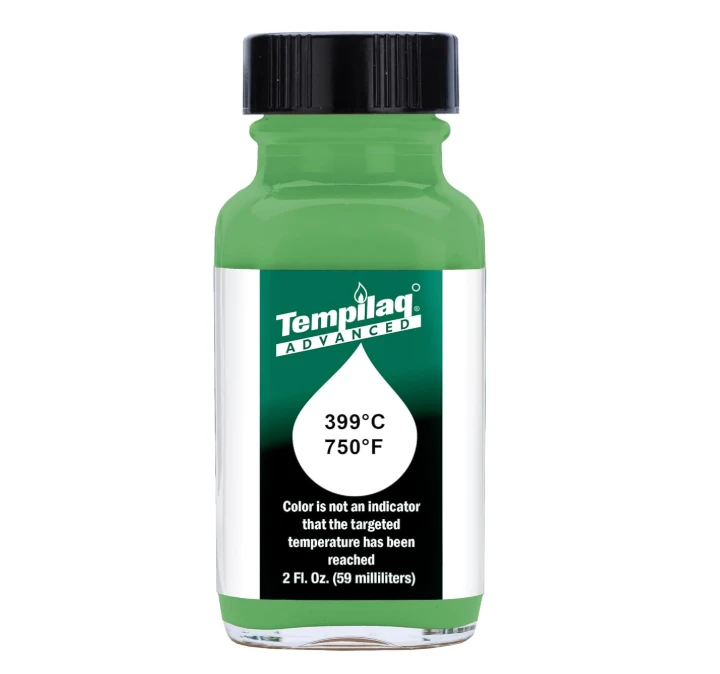
Controlling 190–210°C (374–410°F) with Tempilstik®
The 190–210°C range requires control at both the lower and upper bound. The recommended three-crayon technique:
- Lower bound — #28325 (374°F / 190°C): Crayon melts → surface has reached ≥190°C, confirming the process is entering the effective range. Use to verify that heating is progressing and has reached the target band.
- Mid-band — #28035 (400°F / 204°C): Crayon melts → surface is within the 190–210°C target band. Use during the soak period to spot-check that temperature is being maintained.
- Upper guard — #28328 (410°F / 210°C): This crayon must not melt at any point during the soak. If #28328 melts, surface temperature has exceeded 210°C.
Practical Application: Pre-Galvanizing Stress Relief
Hot-dip galvanizing is the most common application of low-temperature stress relief in Vietnam, particularly for offshore steel structures, bridges, and transmission towers. The procedure:
- Welded assembly (low-carbon steel, P-No.1, no PWHT required by code) is placed in a furnace or heated locally to 190–210°C (374–410°F)
- Soak time: typically 1 hour per 25 mm (1") of maximum thickness — for light-to-medium structures, 30–60 minutes is usually sufficient in practice
- Tempilstik® #28325 (190°C / 374°F) and #28035 (204°C / 400°F) confirm temperature at representative points across the structure (corners, T-joint welds, areas of suspected stress concentration); #28328 (210°C / 410°F) serves as the upper guard — it must not melt throughout the soak
- Cool in still air — no water quench, no compressed air
- Then proceed to galvanizing
Frequently Asked Questions
Does stress relieving at 190–210°C alter the mechanical properties of steel?
Not significantly for ordinary carbon steel (P-No.1, P-No.3). At this temperature range there is no recrystallisation or phase transformation — yield strength and tensile strength change by less than 2–3%, well within engineering tolerances. For steels with precipitation-sensitive microstructures (e.g. high-strength HSLA grades with age-hardening characteristics), consult a materials engineer before applying this treatment.
Why must the structure cool slowly after stress relieving — why not quench with water?
Rapid cooling (quenching) from 190–210°C creates a sudden temperature gradient — the surface cools before the core, generating new thermal stresses that partially cancel the relief just achieved. Water quenching can also cause localised thermal shock at thin welds. Still-air cooling (still air cooling) ensures minimal thermal gradient and preserves the benefit of the heat treatment.
Which Tempilstik® grades should be used to control the 190–210°C (374–410°F) range?
Three crayons are needed for full control: #28325 (374°F / 190°C) — confirms the lower bound has been reached; #28035 (400°F / 204°C) — confirms the surface is within the effective range during the soak; #28328 (410°F / 210°C) — upper guard, must not melt throughout the soak. If #28328 melts, temperature has exceeded 210°C. All three are genuine Tempil® product available from tempil.vn.
Can low-temperature stress relief replace a hydrogen bake-out (post-heat)?
Post-heat (hydrogen bake-out) is typically performed at 200–250°C (392–482°F) for 2–4 hours immediately after welding — the purpose being to allow hydrogen to diffuse out of the weld before it fully cools. A low-temperature stress relief at 190–210°C carried out immediately after welding can fulfil the post-heat function. However, if the WPS specifies a separate post-heat step, that requirement must be followed — the two steps cannot be arbitrarily combined. See also PWHT and Post-Weld Heat Treatment Methods.
Need Tempilstik® #28325 (190°C / 374°F), #28035 (204°C / 400°F), or #28328 (210°C / 410°F) for stress-relieving or pre-galvanizing applications? Fast Group (tempil.vn) is the authorised Tempil® distributor in Vietnam — genuine product with C/O, C/Q, and VAT invoice. Individual sticks and boxes of 10 available.
Request a Quote +84 938 888 958