What is Tempilstik®? — The Complete Field Guide for Welding Engineers
In industrial welding, the question "is the steel surface hot enough?" must be answered with data — not guesswork. Tempilstik® is a direct-contact surface temperature indicating crayon that allows Welding Inspectors and QA/QC Engineers to confirm preheat temperature, interpass temperature, and PWHT compliance on-site — with no power supply, no calibration, and no emissivity errors.
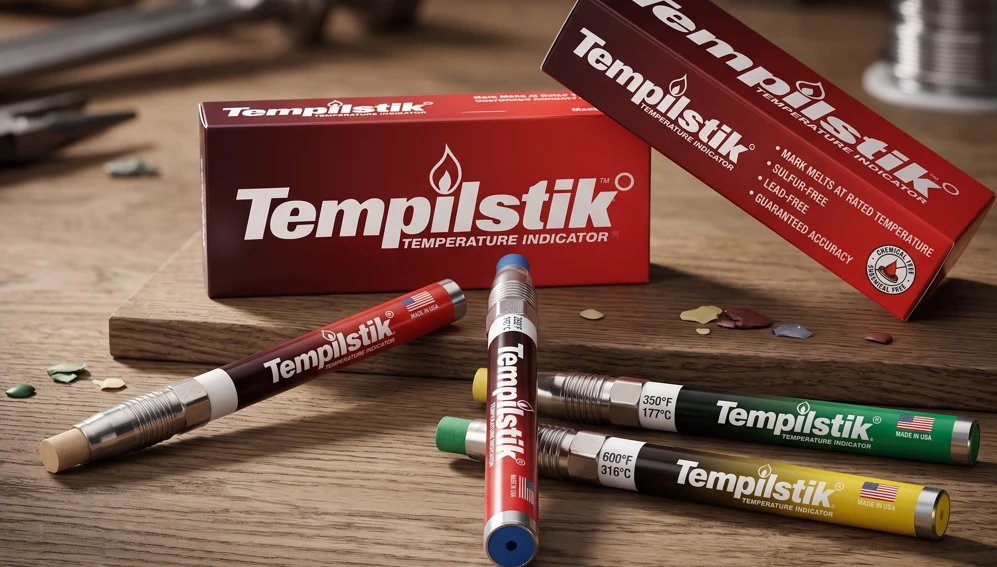
How Tempilstik® Works — the Physical Principle
Tempilstik® is a surface temperature indicating crayon manufactured by Tempil, a brand of Illinois Tool Works (ITW), in the United States. Each crayon is formulated from a chemical compound with a precisely controlled melting point, accurate to ±1% Fahrenheit (±3% Celsius) per the manufacturer's quality standard.
The operating principle is entirely physical — no electronics, no optics:
| Surface Condition | What Happens | Interpretation |
|---|---|---|
| Below rated temperature | Crayon leaves a solid white chalk-like mark on the steel surface. The mark stays solid. | Surface has not reached the required temperature. |
| At or above rated temperature | Crayon melts immediately into a clear liquid on contact with the surface. | Surface has reached or exceeded the threshold. Unambiguous go/no-go signal. |
The melt mark leaves a clear visible trace on the surface that can be photographed as QA/QC documentation — no additional data-logging equipment required.
Temperature Range & Part Number System
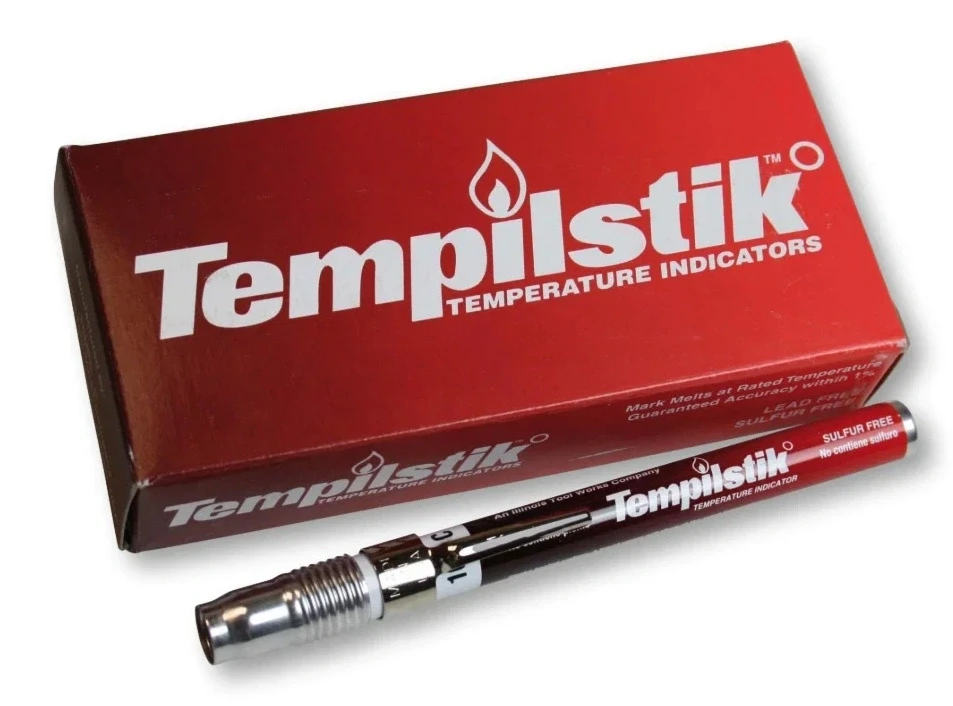
Tempilstik® covers 116 temperature ratings from 100°F (38°C) to 2000°F (1093°C), each with a unique part number. The part number is printed directly on the crayon body and packaging — it is the only reference you need when ordering. Each box contains 10 crayons; individual crayons are also available.
| Part Number | °F | °C | Typical Preheat Application |
|---|---|---|---|
| #28006 | 150°F | 66°C | AWS D1.1 Group I–II thin structural steel — best-selling SKU |
| #28009 | 175°F | 79°C | ASME B31.3 P-No.1 pipe wall ≥ 25 mm, A106 Gr.B |
| #28312 | 230°F | 110°C | AWS D1.1 Group I heavy section, Group II–III thick plate |
| #28019 | 250°F | 121°C | AWS D1.1 Group II plate 20–38 mm, offshore structural |
| #28318 | 302°F | 150°C | AWS D1.1 Group III–IV, ASME P-No.4 (P11, P12) |
| #28327 | 392°F | 200°C | ASME P-No.5A (P22), A335 P91, Cr-Mo alloy piping |
| #28039 | 450°F | 232°C | Stress relief PWHT for carbon steel, ASME VIII pressure vessels |
| #28047 | 600°F | 316°C | PWHT for Cr-Mo steels P91/P22, power plant equipment |
Browse all 116 part numbers (filterable by °C or °F) on the Tempilstik® product page. If your WPS specifies a temperature that falls between two available ratings, always select the lower of the two — this ensures you do not under-read the actual temperature relative to the minimum requirement.
5-Step Field Procedure — AWS D1.1
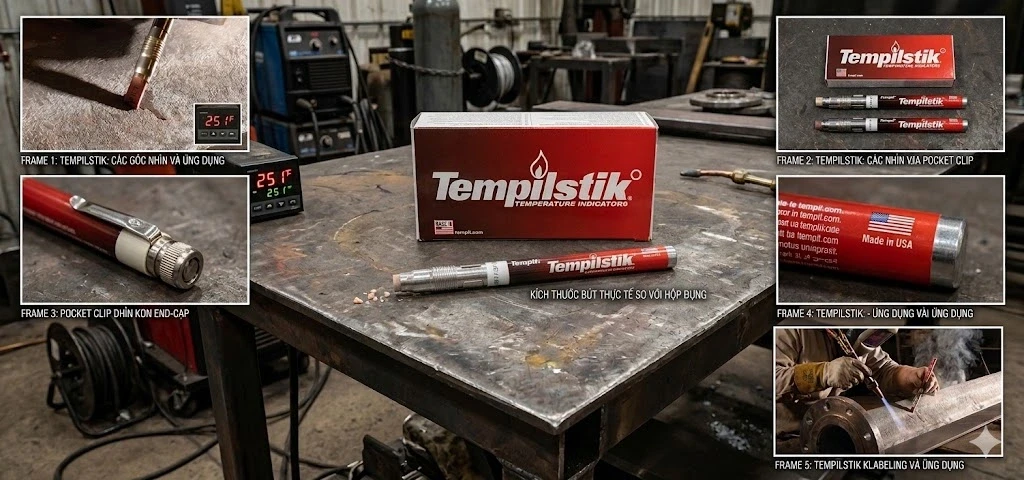
Using Tempilstik® is straightforward, but measurement location and timing directly affect result reliability. The following procedure conforms to AWS D1.1 Section 5 and equivalent ASME requirements.
-
Confirm the required temperature from the WPS.
Refer to the approved Welding Procedure Specification — locate the "Preheat Temperature" or "Minimum Preheat" value. This is the minimum temperature the base metal must reach, not a target. Select the Tempilstik® part number matching that temperature exactly. -
Mark the surface before heating begins.
Draw a thin line on the steel at the measurement location before applying heat. This pre-applied mark will liquefy visibly when the temperature is reached. No firm pressure is needed — Tempilstik® is softer than a pencil; normal hand pressure is sufficient. -
Measure at the correct position — at least 75 mm from the weld edge.
AWS D1.1 requires temperature measurement at a minimum of 75 mm (3 inches) from each side of the weld centerline, at a minimum of 4 evenly distributed points along the weld. This position represents the temperature of the full heat-affected zone (HAZ), not the local temperature at the heat source tip. -
Allow adequate soak time.
For plate thicker than 50 mm, surface temperature reaching the threshold does not guarantee the core is fully heated. Maintain the heat source for an additional 2–5 minutes after the surface reaches the target (the exact time depends on thickness) to ensure heat has penetrated the full cross-section before welding begins. -
Record the result in the QA/QC file.
Photograph the melted mark at the measurement location. Record the Tempilstik® part number and time of measurement in the inspection report. A melt photograph is accepted as visual evidence by most EPC and O&G project QA systems.
Common Mistakes to Avoid
For P91 steel (A335 Gr.P91) and other high-alloy materials, AWS and ASME specify a maximum interpass temperature — typically 300°C (572°F / 482°C per #28053). Exceeding this limit alters the weld microstructure. Use Tempilstik® #28053 (900°F / 482°C) to confirm the surface has not exceeded this threshold before depositing each subsequent pass.
Preheat vs Interpass vs PWHT — Key Differences
The same Tempilstik® crayon serves three distinct temperature control purposes in the welding sequence:
| Application | When to Measure | Purpose | Typical Temperature Range |
|---|---|---|---|
| Preheat | Before striking the arc | Confirm base metal ≥ WPS minimum — reduces cold cracking risk in HAZ | 50–250°C (carbon steel) 150–350°C (alloy steel) |
| Interpass | Between weld passes | Confirm surface does not exceed WPS maximum — prevents toughness loss and adverse microstructure changes | ≤ 200–300°C depending on material |
| PWHT verification | During heat treatment cycle | Confirm surface has reached the required soak temperature | 600–760°C (stress relief) 700–760°C (P91) |
For PWHT at elevated temperatures (above 600°C / 1112°F), Tempilstik® remains fully functional — the range extends to 2000°F (1093°C). However, for industrial furnace PWHT where temperature must be continuously recorded, best practice is to use a thermocouple system as the primary record and Tempilstik® for independent spot-check verification.
Accepted Standards
For QA/QC Engineers documenting measurement methods in inspection records, Tempilstik® is recognized as a valid direct-contact temperature measurement method by the following standards:
- AWS D1.1 — Structural Welding Code: Steel
- ASME Section I — Power Boiler Construction
- ASME Section III — Nuclear Components
- ASME Section VIII — Pressure Vessel Construction
- ASME B31.1 — Power Piping
- ASME B31.3 — Process Piping
- API 1104 — Welding of Pipelines and Related Facilities
- EN 1011-2 — Welding of metallic materials (arc welding of ferritic steels) — widely used in European-led EPC projects across Southeast Asia
Temperature indicating crayons listed in these standards do not require periodic recalibration schedules because the measurement mechanism is chemical — not electronic — and therefore has no drift requiring correction.
Selecting the Right Part Number from Your WPS
In practice, WPS documents state preheat temperature in Celsius. The fastest method to select the correct part number:
- Read the minimum preheat temperature from the WPS (°C)
- Convert to °F:
T°F = T°C × 9/5 + 32 - Find the Tempilstik® part number whose rating is closest to — but not lower than — the required temperature
- If two adjacent ratings straddle the requirement, select the lower one to detect the precise threshold
→ Browse the complete 116-SKU list at the Tempilstik® product page — filterable by °C or °F.
Available as a box of 10 crayons or individually. Stock held in Ho Chi Minh City and Vung Tau.
Related products for complete temperature control:
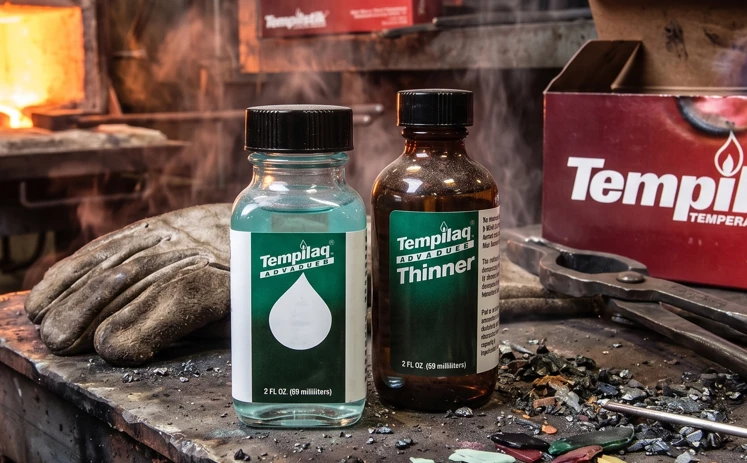
- Tempilaq® Advanced — liquid temperature indicator, ideal for marking large areas or monitoring maximum interpass temperature
- Tempilabel® — self-adhesive temperature indicator labels for equipment monitoring and continuous surface surveillance
- Thermomelt® — fusible pellets for furnace and oven temperature verification
Frequently Asked Questions
Need to order Tempilstik® for your project?
Fast Group Engineering is the authorized Tempil® distributor in Vietnam — direct import from the USA, with C/O (Certificate of Origin), C/Q (Certificate of Quality), and VAT invoice. Available as a box of 10 or individual crayons.
📞 +84 938 888 958 | ✉ sales@tempil.vn