PWHT — Post Weld Heat Treatment: ASME Requirements & the Role of Tempilstik® in Temperature Verification
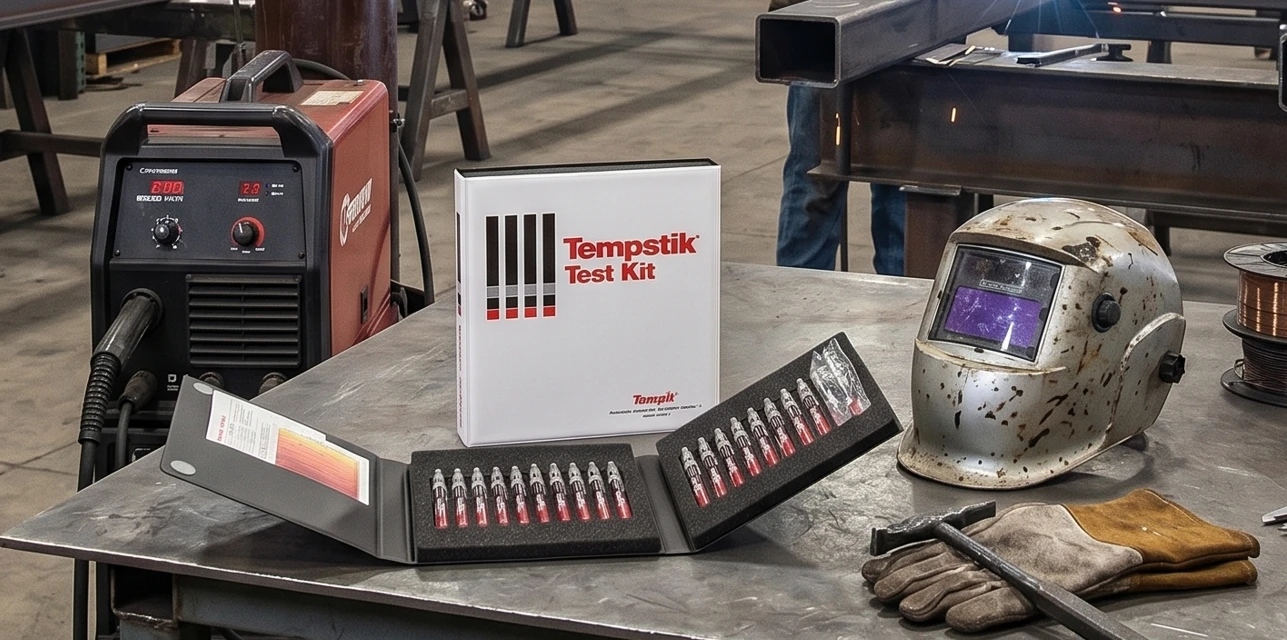
Post Weld Heat Treatment (PWHT) is a mandatory heat treatment step under ASME and EN codes for many alloy steels and heavy-section welds. Unlike preheat or interpass temperature control — which are performed during welding — PWHT is an independent thermal cycle applied after the weld is complete: heat the joint to the specified temperature, hold for a defined soak time, then cool at a controlled rate. Thermocouples and a data logger are the primary instruments for PWHT; however, Tempilstik® plays a valuable supplementary role — providing spot-check confirmation that the actual component surface has reached the required temperature, filling in the gaps between fixed thermocouple attachment points.
What is PWHT — Definition and Metallurgical Purpose
PWHT is a controlled heating process applied to a completed weld after it has cooled to ambient temperature (or to a temperature defined by the applicable code). Its technical purpose is not a single objective — it simultaneously addresses three metallurgical problems introduced by the welding process:
Welding generates extreme thermal gradients over very short time periods. Uneven expansion and contraction introduce residual stress — sometimes approaching the yield strength of the material. PWHT at sufficient temperature softens the crystal lattice, allowing limited plastic deformation to release this stored stress.
For alloy steels (Cr-Mo, Cr-Mo-V), the welding thermal cycle produces hard, brittle martensite in the HAZ. PWHT tempering transforms this martensite into bainite or sorbite — microstructures with significantly higher impact toughness, suited for high-temperature and high-pressure service.
While preheat already assists hydrogen diffusion during welding, PWHT at elevated temperature drives this process more completely — reducing the risk of delayed cold cracking (hydrogen-induced cracking) that can develop hours or days after welding.
Distinguishing Preheat, Interpass, and PWHT
| Parameter | When Applied | Type of Control | Purpose |
|---|---|---|---|
| Preheat | Before welding begins | MINIMUM | Slow down HAZ cooling rate; reduce hydrogen-induced cold cracking risk; reduce thermal shock |
| Interpass | Between each weld pass | MAXIMUM | Prevent overheating — excessive interpass temperature reduces impact toughness and produces adverse microstructural changes |
| PWHT | After weld is complete and cooled | INDEPENDENT CYCLE | Stress relief, HAZ tempering, hydrogen diffusion — a complete, separate thermal treatment cycle |
Preheat and interpass temperature can be verified with Tempilstik® throughout the welding process. PWHT requires a more comprehensive measurement system because the temperatures involved are substantially higher and the soaking time must be fully documented to satisfy third-party inspection requirements.
PWHT Temperatures per ASME — P-Number Classification
ASME classifies weld materials by P-Number (material group) to define PWHT requirements. The following table summarizes stress relief PWHT temperatures for the steel groups most commonly encountered in Vietnam's refinery, petrochemical, and power generation sectors:
| P-Number (ASME) | Steel Type | Typical Grade / Spec | PWHT Temperature Range | Min Soak Time | Tempilstik® Spot-Check |
|---|---|---|---|---|---|
| P1 | Carbon steel | A106 Gr.B, A53, A516 | 580–620°C (1076–1148°F) | 1 hr per 25 mm thickness | #28047 (600°F / 316°C) — verify heating phase |
| P4 | Low Cr-Mo alloy | A335 P11 (1¼Cr-½Mo) | 600–650°C (1112–1202°F) | 1 hr per 25 mm | #28047, #28057 (1022°F / 550°C) |
| P5A | Cr-Mo alloy | A335 P22 (2¼Cr-1Mo) | 700–760°C (1292–1400°F) | 2 hr minimum | #28057 (550°C), #28065 (1450°F / 788°C) |
| P5B | Cr-Mo-V alloy | A335 P91 (9Cr-1Mo-V) | 730–760°C (1350–1400°F) | 1 hr minimum (no exceptions) | #28065 (1450°F / 788°C) — mandatory |
| P8 | Austenitic stainless | A312 TP304, TP316 | Solution anneal 1040–1120°C | Thickness-dependent | Outside standard Tempilstik® range |
The Role of Tempilstik® in PWHT
A question frequently raised by QA/QC Engineers: "We already have thermocouples and a data logger — what does Tempilstik® add to a PWHT operation?"
The answer lies in the fundamental difference between the two measurement methods:
| Method | Coverage | Output | Primary Use |
|---|---|---|---|
| Thermocouple + data logger | Fixed attachment points — typically on or near the weld surface per WPS | Continuous time-temperature record — mandatory QA documentation | Primary PWHT record — soak time evidence |
| Tempilstik® | Any accessible surface — applied by inspector at locations thermocouple cannot reach | Go/no-go confirmation that a specific temperature threshold was reached at that location | Supplementary spot-check at complex geometry points |
Specific ways Tempilstik® supplements the thermocouple system during PWHT:
- Spot-check at thermocouple-free zones: Mark Tempilstik® on flange faces, nozzle base pads, thick fittings, or recessed corners — if the mark melts, that location has reached the required temperature.
- Pre-soak confirmation: Before starting the soak time clock, use Tempilstik® to sweep the points farthest from the heat source — confirming that the entire component has reached the target temperature uniformly, not just the thermocouple attachment zones.
- Supplementary evidence when thermocouple readings are questioned: If the data logger output is anomalous or a thermocouple becomes loose during heating, the Tempilstik® melt marks on the component surface provide independent physical evidence for the QA record.
- Indirect heating rate monitoring: For large components, marking multiple crayons at progressively higher temperatures and recording the order in which they melt gives a practical indication of whether heat is distributing uniformly through the section.
Tempilstik® Part Numbers for PWHT Verification
PWHT temperatures (580–760°C) fall within the Tempilstik® operating range, but selecting the correct part number for a meaningful spot-check requires understanding the verification strategy. The principle: select a part number whose rating is at or below the minimum PWHT soaking temperature — when that crayon melts, you can confirm the surface has passed that threshold.
| Part Number | Temperature (°F / °C) | PWHT Application | Applicable Steel Group |
|---|---|---|---|
| #28047 | 600°F / 316°C | Low-temperature checkpoint during heating phase — verify surface has passed 316°C | P1 (carbon steel) |
| #28057 | 1022°F / 550°C | Intermediate checkpoint in P4/P5A heating cycle | P4 (P11), P5A (P22) |
| #28061 | 1400°F / 760°C | Spot-check confirming surface has passed 760°C — uniform heating check before soaking | P1 (uniform heat verification) |
| #28065 | 1450°F / 788°C | Spot-check in P22 and P91 PWHT — confirm surface ≥ 788°C prior to soaking | P5A (P22), P5B (P91) |
→ Full product listing at the Tempilstik® page — filterable by °C or °F. Stock in Ho Chi Minh City and Vung Tau.
Frequently Asked Questions
Need Tempilstik® for PWHT verification or welding temperature control?
Fast Group Engineering is the authorized Tempil® distributor in Vietnam — direct import from the USA, with C/O, C/Q, and VAT invoice. Stock in Ho Chi Minh City and Vung Tau.
📞 +84 938 888 958 | ✉ sales@tempil.vn