Interpass Temperature in Welding — Control Methods per AWS D1.1 & ASME
Of the three core thermal control concepts in technical welding — preheat, interpass, and PWHT — interpass temperature is the one most frequently misunderstood. Many engineers confuse interpass with preheat because both involve measuring base metal temperature before welding. The critical distinction: preheat is a minimum threshold required before the first weld pass; interpass temperature is the maximum threshold that must not be exceeded between subsequent passes. Failing to control interpass — especially overheating — causes weld metal property degradation that is invisible to the naked eye and undetectable by routine VT or PT inspection.
Precise Definition — What is Interpass Temperature?
Interpass temperature is the temperature of the base metal in the weld zone, measured immediately before depositing the next pass in a multi-pass weld. Two points in this definition are critical:
- "Immediately before" — not during welding, and not the moment the arc is extinguished. Wait for the arc to stop, then measure before starting the next pass.
- "Maximum" — this is an upper limit, not a target. A WPS stating "interpass ≤ 250°C" means the temperature at the time of measurement must be at or below 250°C. If higher, stop and allow cooling.
The measurement point is the base metal surface approximately 25 mm (1 inch) from the weld toe, or as specified in the WPS. Do not measure on the just-deposited weld bead itself.
| Stage | Parameter | Type of Limit | Purpose |
|---|---|---|---|
| Before welding | Preheat ≥ Tmin | MINIMUM | Heat base metal to minimum — confirm before first pass |
| Between passes | Interpass ≤ Tmax | MAXIMUM | Measure before each subsequent pass — stop if limit exceeded |
| After completion | PWHT 580–760°C | SEPARATE CYCLE | Stress relief and HAZ improvement — independent heat treatment cycle after weld cools |
Why Maximum Interpass Matters — Metallurgical Consequences of Overheating
When the temperature between passes is too high, the base metal and previously deposited weld passes experience an additional, uncontrolled thermal cycle. The specific metallurgical consequences depend on the steel type, but the common mechanisms include:
Extended time at elevated temperature promotes grain growth in the heat-affected zone. Coarse grains reduce impact toughness (Charpy V-notch energy) — particularly critical for steels with low-temperature CVN requirements.
For alloy steels such as P11 and P22, elevated interpass temperature over extended periods can cause brittle-phase precipitation at grain boundaries — a form of property degradation not detectable by standard non-destructive examination methods.
For thin-section structures or small components, accumulated heat causes thermal distortion that is harder to control and correct.
P91 steel is particularly sensitive — interpass overheating affects carbide distribution and long-term creep resistance, with consequences that may only manifest after thousands of hours of service at elevated temperature.
Maximum Interpass Limits by Material Type
Maximum interpass temperature limits are not published in a single universal table — they are determined in the WPS based on material type, welding process, and mechanical property requirements. The following typical values are commonly encountered in Vietnamese industrial practice:
| Material / Steel Type | Typical Grade / Spec | Typical Max Interpass | Technical Reason | Tempilstik® Part No. |
|---|---|---|---|---|
| Carbon structural steel | SS400, A36, SM490 | 250–300°C (482–572°F) | Prevent HAZ grain coarsening; control distortion | #28039 (232°C) / #28053 (300°C) |
| Cr-Mo-V alloy (P91) | A335 P91, A182 F91 | ≤ 300°C (572°F) | Protect martensite tempering structure; prevent adverse carbide precipitation | #28053 (572°F / 300°C) |
| Cr-Mo alloy (P11, P22) | A335 P11, A335 P22 | 250–300°C (482–572°F) | Control temper embrittlement; maintain toughness | #28039 (232°C) / #28053 (300°C) |
| Duplex stainless steel | UNS S31803, S32205 | ≤ 150°C (302°F) | Prevent sigma phase precipitation — causes severe embrittlement and loss of corrosion resistance | #28318 (302°F / 150°C) |
| Austenitic stainless steel | TP304, TP316, TP321 | ≤ 175°C (347°F) | Prevent sensitization (chromium carbide precipitation at grain boundaries) causing intergranular corrosion (IGC) | #28318 (150°C) or #28025 (177°C) |
| Pipeline steel | API 5L Gr.B, X52, X65 | 250°C (482°F) — WPS dependent | Similar to structural carbon steel — refer to API 1104 | #28039 (232°C) |
The Two-Crayon Technique — Simultaneous Preheat Min & Interpass Max Control
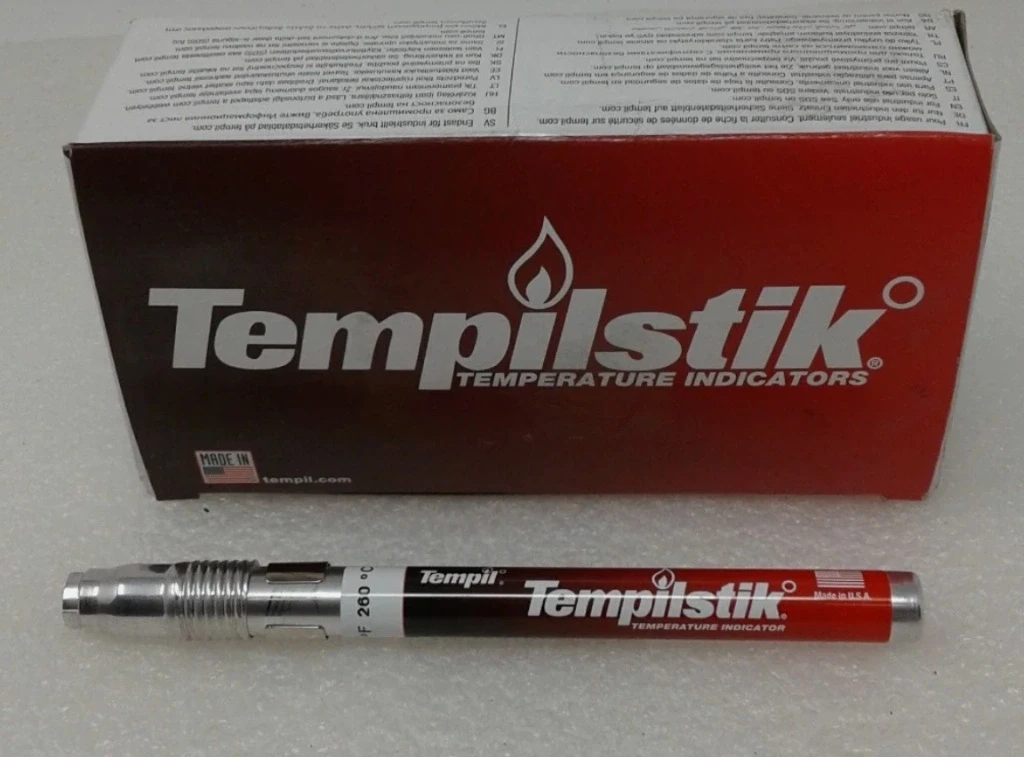
This is standard practice in high-quality welding programs: using two Tempilstik® crayons at different ratings to define the permitted welding window — confirming both the minimum preheat has been reached and the maximum interpass has not been exceeded before each pass.
Crayon #1 — Minimum Preheat
Mark the surface before welding begins.
- If not melted → surface below minimum → continue heating
- If melted → minimum temperature reached → permitted to weld
Example: #28006 (66°C) for SS400 structural steel; #28318 (150°C) for P11
Crayon #2 — Maximum Interpass
Mark before each subsequent pass.
- If not melted → temperature within limit → permitted to continue
- If melted → too hot → stop, allow cooling, re-measure
Example: #28039 (232°C) or #28053 (300°C) depending on WPS
The field logic: before depositing each pass, the inspector marks both crayons on the base metal surface adjacent to the weld. The condition for welding to proceed is:
If either condition is not met, welding must stop.
Common Crayon Pairs — Offshore and Industrial Applications in Vietnam
| Application | Crayon #1 (Preheat Min) | Crayon #2 (Interpass Max) |
|---|---|---|
| Structural carbon steel (SS400 / SM490) | #28006 — preheat ≥ 66°C | #28039 — interpass ≤ 232°C |
| P91 alloy pipe welding | #28327 — preheat ≥ 200°C | #28053 — interpass ≤ 300°C |
| Duplex stainless steel pipe | #28009 — preheat ≥ 79°C | #28318 — interpass ≤ 150°C |
Correct Field Measurement Procedure
- Complete the weld pass. Stop welding and remove or extinguish the electrode/wire.
- Remove slag from the deposited pass using a chipping hammer and wire brush. Slag is an insulator — leaving it in place will produce an artificially high surface temperature reading.
- Wait 30–60 seconds before measuring. Allow heat from the weld bead to redistribute into the surrounding base metal. Measuring immediately after the arc stops gives an inflated reading that does not represent the true HAZ temperature.
-
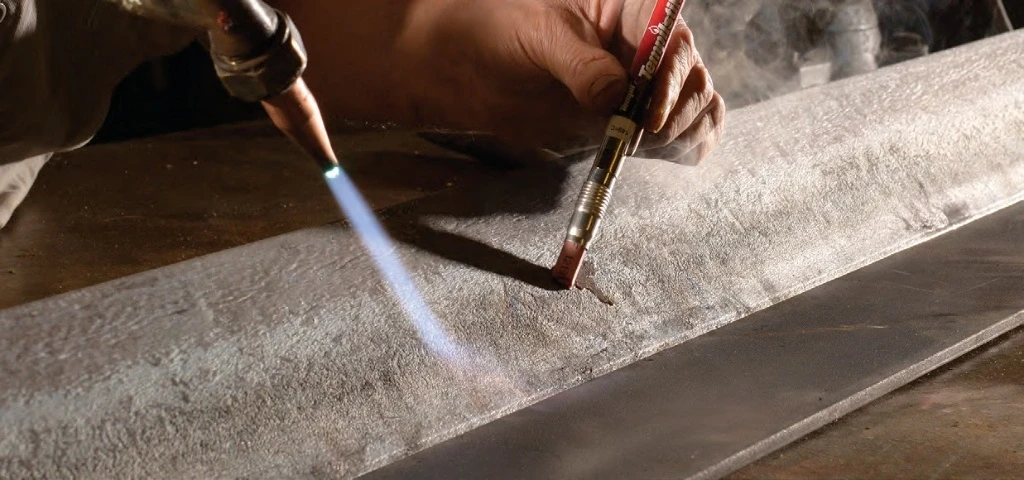
Mark the interpass crayon (e.g. #28053) on the base metal surface 25 mm from the weld toe.
- Mark stays solid (chalky, dry): surface temperature is below the crayon's rated temperature → within the interpass limit → check the preheat crayon to confirm the joint has not cooled below minimum, then proceed with welding.
- Mark liquefies immediately: surface temperature is at or above the rated temperature → above the maximum interpass limit → stop, allow natural cooling, re-measure until within range.
- Record in the QA/QC file: pass number, time of measurement, result (pass/fail), action taken.
Quick-Reference Part Numbers for Interpass Temperature Control
| Part Number | Temperature (°F / °C) | Used to verify maximum interpass for | Notes |
|---|---|---|---|
| #28318 | 302°F / 150°C | Duplex stainless (≤ 150°C); austenitic SS (reference) | Lowest interpass limit — most common for duplex |
| #28025 | 350°F / 177°C | Austenitic SS (≤ 175°C per some WPS) | — |
| #28039 | 450°F / 232°C | Carbon structural steel (≤ 250°C); pipeline steel API 5L | Most common interpass check for carbon steel |
| #28053 | 572°F / 300°C | Carbon steel (≤ 300°C); P11; P22; P91 — mandatory | Most important part number for pressure piping interpass |
For minimum preheat part number selection by material and thickness, see the preheat temperature reference table — AWS D1.1, ASME B31.3, API 1104. For the full range of 116 Tempilstik® part numbers, visit the Tempilstik® product page.
Frequently Asked Questions
Need Tempilstik® for preheat and interpass control?
Fast Group Engineering is the authorized Tempil® distributor in Vietnam — direct import from the USA, with C/O, C/Q, and VAT invoice. Stock in Ho Chi Minh City and Vung Tau. Available as a box of 10 or individual crayons.
📞 +84 938 888 958 | ✉ sales@tempil.vn