What Is Tempilstik®? A Field Usage Guide for Welding Engineers and QC Inspectors
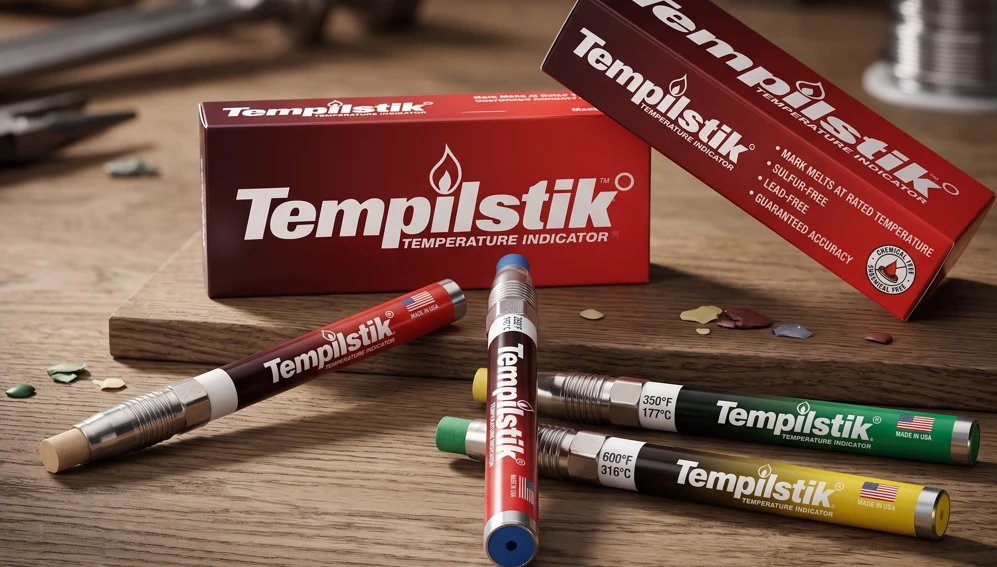
Tempilstik® is a temperature indicating crayon used to verify surface temperature on metal during welding, preheating, heat treatment, and pre-paint inspection. For welding supervisors and QC inspectors, it provides immediate confirmation of preheat temperature, interpass temperature, and critical thermal checkpoints — with no electronics, no calibration, and no dependence on surface emissivity.
Unlike infrared thermometers that rely heavily on the surface being measured, its reflectivity, and emissivity settings, the temperature indicating crayon works on a phase-change principle: when the surface reaches the crayon's rated temperature, the mark melts from solid to a transparent liquid — a clear, unambiguous pass/fail signal at the point of contact.
How Tempilstik® Works
Each Tempilstik® stick is formulated to a single rated temperature. When a welding engineer lightly draws the crayon across a metal surface that is being heated, the indicating material melts immediately if the surface has reached the corresponding temperature. If the mark remains solid, the surface has not yet reached the required level.
This mechanism is entirely physical — no electronics, no optical path, no batteries:
- Below rated temperature: The crayon leaves a solid white chalk-like mark. The mark holds its shape — the surface is not yet at temperature.
- At rated temperature: The crayon melts instantly into a clear liquid on contact. This is an unambiguous signal — the surface has reached or exceeded the required threshold.
- Documented evidence: The melted mark remains visible on the surface and can be photographed for QA/QC records without additional data-logging equipment.
When to Use a Temperature Indicating Crayon
Temperature control is not a supplementary step in industrial welding — it is a mandatory quality parameter. If preheat temperature is insufficient, the base metal cools too rapidly after welding, increasing the risk of hydrogen-induced cracking, residual stress, and HAZ property degradation.
| Application | Control Objective | Typical User |
|---|---|---|
| Preheat before welding | Confirm surface has reached the WPS minimum temperature | Welder, Welding Supervisor |
| Interpass temperature | Ensure the joint is not too cold or too hot between passes | QC Inspector, Welding Engineer |
| Pre-assembly heating | Control temperature during local heating for fit-up or shrink fitting | Maintenance Team |
| Field inspection | Rapid on-site verification of thermal conditions | QA/QC, Client Inspector, TPI |
In offshore environments, power plants, oil and gas facilities, and structural steel shops operating in Vietnam, the combination of simplicity, portability, and freedom from calibration requirements makes the temperature indicating crayon the preferred first-line verification method.
How to Use Tempilstik® Correctly — Step-by-Step Field Procedure
The mechanics of using Tempilstik® are straightforward, but measurement location and timing directly affect result reliability. The following procedure conforms to AWS D1.1 Section 5 and equivalent ASME requirements.
Identify the minimum preheat temperature in the approved Welding Procedure Specification (WPS). This is the floor — not a target. Choose the Tempilstik® part number that matches exactly. If the WPS temperature falls between two available ratings, select the lower rating to ensure detection precisely at the required threshold.
Draw a thin line on the base metal surface at the intended measurement point before heating starts. The mark creates a cold reference that will liquefy once the surface reaches the rated temperature. Light hand pressure is sufficient — the crayon is softer than a pencil and does not require firm force.
AWS D1.1 requires measurement at a minimum of 75 mm (3 inches) from the weld fusion line on each side, at least four evenly distributed points along the joint length. This position represents the temperature of the full HAZ, not the local temperature at the heating torch tip.
For base metal over 50 mm thick, surface temperature reaching the threshold does not mean the full cross-section is at temperature. Maintain the heat source for an additional 2–5 minutes (depending on thickness) to allow heat to penetrate through the section before welding begins.
Photograph the melted crayon marks at each measurement point. Record the Tempilstik® part number, measurement location, ambient conditions, and timestamp in the inspection report. A photograph of a melted mark is accepted as direct visual evidence by most EPC and O&G project QA systems operating in Vietnam.
Selecting the Right Part Number for Your WPS
WPS documents in Vietnam typically specify preheat temperatures in Celsius. The fastest method for part number selection:
- Take the minimum preheat temperature from the WPS (in °C)
- Convert to °F: T°F = T°C × 9/5 + 32
- Find the part number whose rated temperature is closest to — but not below — the required temperature
- If two adjacent ratings exist, select the lower one to detect exactly when the threshold is crossed
Practical example: WPS requires minimum preheat of 100°C → Convert: 100 × 9/5 + 32 = 212°F → Select #28016 (225°F / 107°C). When the crayon melts, the surface is confirmed at ≥ 212°F.
Commonly specified part numbers for welding preheat control in Vietnam:
| Part Number | Temperature °F | Temperature °C | Typical Preheat Application |
|---|---|---|---|
| #28006 | 150°F | 66°C | AWS D1.1 Category I–II thin carbon steel — highest-volume SKU |
| #28009 | 175°F | 79°C | ASME B31.3 P-No.1 pipe ≥ 25 mm wall, A106 Gr.B |
| #28019 | 250°F | 121°C | AWS D1.1 Category II heavy plate 20–38 mm, offshore structure |
| #28312 | 230°F | 110°C | AWS D1.1 Category I very thick, Category II–III medium alloy |
| #28318 | 302°F | 150°C | AWS D1.1 Category III–IV; ASME P-No.4 (P11, P12) |
| #28327 | 392°F | 200°C | ASME P-No.5A (P22), A335 P91, Cr-Mo alloy piping |
| #28039 | 450°F | 232°C | PWHT stress relief for carbon steel; ASME VIII pressure vessels |
| #28047 | 600°F | 316°C | PWHT for Cr-Mo P91/P22 steel; power plant equipment |
Who Is Tempilstik® For?
Tempilstik® is the right tool for welding engineers, welding supervisors, QC inspectors, maintenance teams, EPC contractors, and structural fabrication shops. For any operation requiring temperature confirmation without full dependence on electronic instruments, the temperature indicating crayon delivers a simple, durable, field-deployable solution.
For teams managing QA documentation, weld acceptance records, or site inspections, having the correct Tempilstik® ratings on hand for the WPS requirements reduces hold time, eliminates measurement disputes, and supports a stable production workflow.
Compliance with Welding Standards
Temperature indicating crayons are listed as a valid direct-contact temperature measurement method in:
- AWS D1.1 — Structural Welding Code: Steel
- ASME Section I — Boiler and Pressure Vessel Code (Boilers)
- ASME Section III — Nuclear Components
- ASME Section VIII — Pressure Vessels
- ASME B31.1 — Power Piping
- ASME B31.3 — Process Piping
- API 1104 — Welding of Pipelines and Related Facilities
- EN 1011-2 — Welding recommendations, arc welding of ferritic steels
No periodic calibration is required because the measurement mechanism is chemical — a fixed-composition compound with a factory-certified melt point. There is no electronic drift and no mechanical component subject to wear.
Common Field Errors to Avoid
- Measuring directly at the heat source: Temperature at the torch tip or induction coil is significantly higher than the actual HAZ temperature. Measuring at the source gives a false "at temperature" reading while the weld zone remains below the required level. Always measure at least 50 mm away from the heat source.
- Single-point measurement only: Temperature is not uniformly distributed along a long weld joint — especially in complex structures with bulkheads or stiffeners acting as heat sinks. Measure at a minimum of four evenly spaced points per weld run.
- Using the wrong part number: If the WPS requires 150°C (302°F) but a 200°C (392°F) crayon is used, the surface may have already reached 150°C while the crayon remains solid — giving a false "not yet at temperature" result. Verify the part number before every shift.
- Ignoring maximum interpass temperature: After the first weld pass, interpass temperature also requires monitoring — it must not exceed the maximum stated in the WPS. Use a higher-rated Tempilstik® (e.g., #28053 at 900°F / 482°C) to verify the interpass ceiling is not breached.
- Improper storage: Crayons stored in a vehicle parked in direct sunlight or near a heat source may deform at the tip, altering the effective melt point. Store in a dry, cool location away from temperatures exceeding 40°C (104°F).
Preheat vs. Interpass Temperature vs. PWHT — Three Distinct Applications
| Application | Timing | Purpose | Typical Temperature Range |
|---|---|---|---|
| Preheat | Before first arc strike | Ensure surface ≥ minimum WPS temperature | 50–250°C (carbon steel) 150–350°C (alloy steel) |
| Interpass | Between weld passes | Verify maximum interpass limit is not exceeded | ≤ 200–300°C depending on material |
| PWHT verification | During post-weld heat treatment | Spot-check that surface has reached the soaking temperature | 600–760°C (stress relief) 730–760°C (P91) |
For PWHT at temperatures above 600°C (1112°F), Tempilstik® remains operational — the product range extends to 2000°F (1093°C). For furnace PWHT where continuous data logging is required, the best practice is to combine thermocouple data recorders with Tempilstik® spot-checks for supplementary surface verification at locations not directly contacted by thermocouples.
Frequently Asked Questions
Does Tempilstik® require periodic calibration?
No. The product operates on a chemical phase-change mechanism — the melt point of the compound is factory-certified and does not drift over time when stored correctly. There is no electronic sensor subject to drift and no mechanical component requiring inspection. This is a significant advantage during QA audits where calibration traceability of measurement equipment is reviewed.
Can Tempilstik® be used outdoors in rain or humidity?
Yes. The crayon functions reliably in wet conditions because the measurement mechanism is direct thermal contact — not optical or electronic. However, wet steel surfaces lose heat faster once the heat source is removed, so measurement must be taken immediately after heating stops. Strong wind also accelerates surface cooling — account for this when maintaining preheat outdoors.
How many marks does one crayon produce?
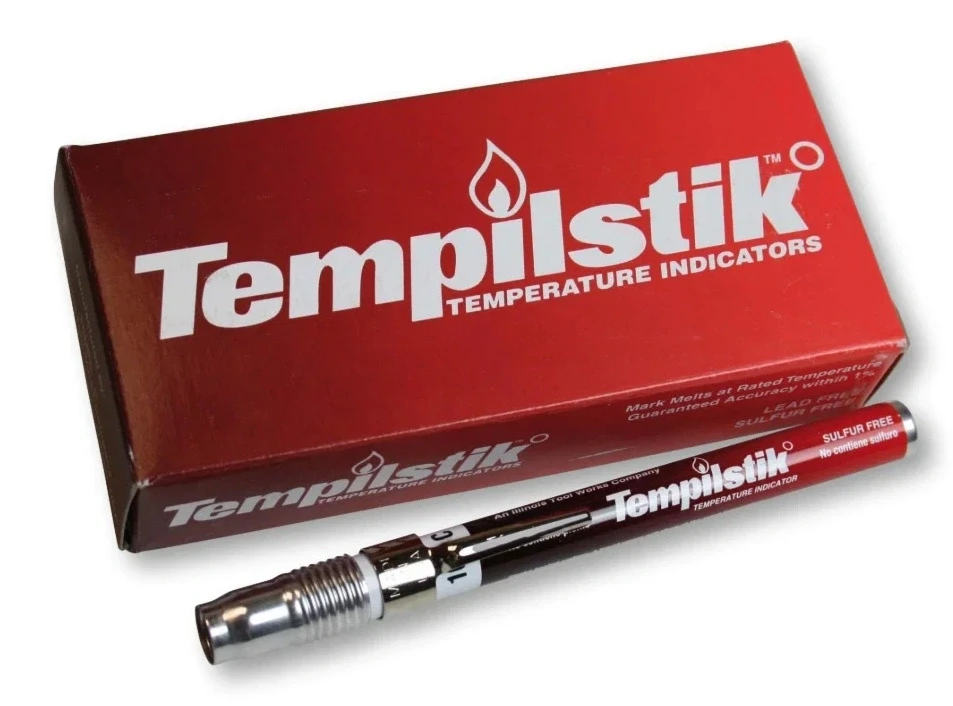
Depending on application pressure and mark length, a standard 150 mm crayon typically produces approximately 20–40 measurement marks. The crayon extends from a metal sleeve as it is used, similar to a mechanical pencil — the remaining length is protected from breakage by the sleeve.
Is Tempilstik® safe for skin contact?
Current production Tempilstik® (manufactured from 2012 onward) is lead-free and sulfur-free — confirmed on the product label. No adverse effects from normal skin contact. Avoid contact with eyes or face. Full material composition is available in the Safety Data Sheet (SDS) supplied with genuine product.
Can Tempilstik® be used on stainless steel?
Yes — Tempilstik® works on austenitic stainless (304, 316) and duplex grades. Note that older sulfur-containing formulations could cause localized corrosion on stainless at elevated temperatures. The current sulfur-free range eliminates this concern, but review the SDS before applying to stainless systems under pressure at high temperatures.
Need a quote for Tempilstik® for a project? tempil.vn is the authorized Tempil® distributor in Vietnam — direct import from USA, with Certificate of Origin (C/O), Certificate of Quality (C/Q), and VAT invoice. Available by box of 10 or individual crayon.
Request a Quote 0938 888 958