Tempilstik® vs Infrared Thermometer — Technical Comparison for Industrial Preheat Inspection
When a QC inspector has two options in hand — a Tempilstik® temperature indicating crayon and an infrared (IR) thermometer — the question is not which one cost more. It is which one is more trustworthy under the actual conditions on this site. Both instruments measure surface temperature, but through completely different physical mechanisms, and that difference has significant implications for structural steel and O&G pipeline welding. This article is a technical analysis — not a sales pitch — to help QA/QC engineers and welding inspectors make the right choice for each specific situation.
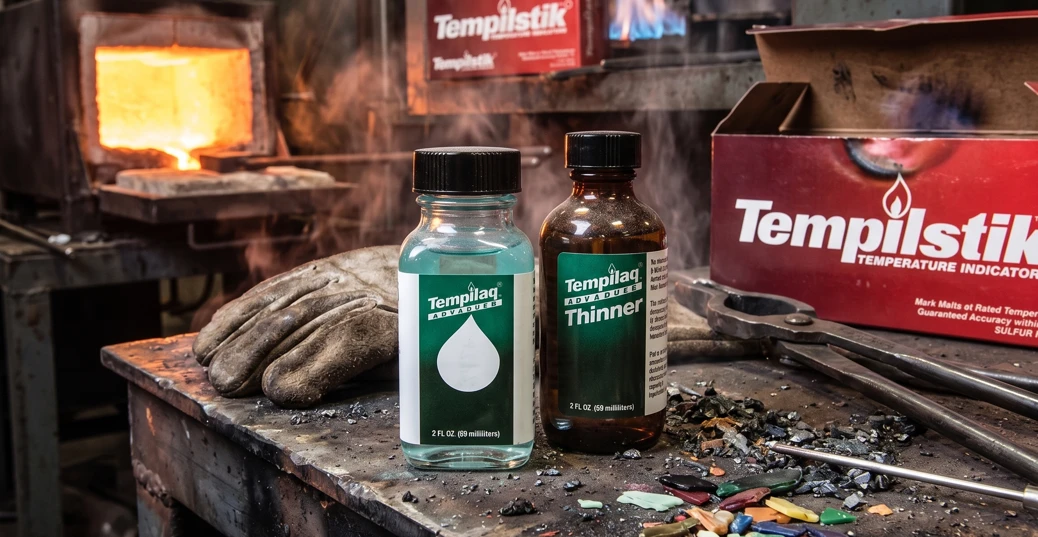
Operating Principles — the Fundamental Difference
Infrared Thermometer
An IR thermometer measures the infrared radiation emitted from an object's surface and converts it to a temperature reading via the Stefan–Boltzmann relationship. More precisely, the device measures radiation from the surface — not the actual temperature of the material. Accuracy depends entirely on the emissivity value (ε) programmed into the device.
Tempilstik® Temperature Indicating Crayon
Tempilstik® operates through pure physical chemistry: a wax compound formulated to melt at a precisely defined temperature. When the surface reaches that temperature, the crayon mark melts immediately — with no dependence on any surface parameter. No emissivity setting, no measurement angle, no spot-size factor, no background radiation.
Emissivity — the Primary Error Source for IR Thermometers
The emissivity of steel varies substantially with surface condition. This is the core vulnerability of IR thermometers in industrial welding applications:
| Steel Surface Condition | Actual Emissivity (ε) | Temperature Error if ε Set to 0.95 |
|---|---|---|
| Mirror-polished steel | 0.07–0.10 | Very large: 40–80°C (72–144°F) |
| Hot-rolled steel with mill scale | 0.70–0.80 | 5–15°C (9–27°F) |
| Lightly rusted steel | 0.80–0.85 | 3–8°C (5–14°F) |
| Epoxy primer-coated steel | 0.85–0.90 | 2–5°C (4–9°F) |
| Brushed stainless steel | 0.15–0.35 | Large: 20–50°C (36–90°F) |
| Blast-cleaned steel (SSPC SP10) | 0.90–0.95 | Small: < 2°C (4°F) |
On a typical offshore construction or fabrication site, steel surfaces are in a mix of states — mill scale, light rust, and primer — with actual emissivity in the range 0.70–0.90. A standard IR thermometer shipped with a factory default of ε = 0.95 will read 5–15°C low on the most common construction-site surfaces.
Comprehensive 14-Criterion Comparison
| Criterion | Tempilstik® | IR Thermometer |
|---|---|---|
| Measurement mechanism | Direct contact — physical chemistry | Infrared radiation — optical |
| Affected by emissivity | No — completely independent | Yes — primary error source |
| Accuracy (ideal conditions) | ±1%°F / ±3%°C | ±1–2°C (with correct ε) |
| Accuracy (mill-scale surface) | ±1%°F — unchanged | ±5–15°C — surface dependent |
| Outdoor wind / rain effect | No effect on measurement | Background radiation and moisture can affect reading |
| Reflected heat interference | None | Furnaces or flames nearby cause false high readings |
| Calibration requirement | None — chemical mechanism is inherently stable | Periodic calibration required (typically annual) |
| QA/QC documentation | Visible melt mark — photographable evidence | Number on a display — requires separate logging |
| Accepted by standards | AWS D1.1, ASME, API 1104, EN 1011-2 | AWS D1.1, ASME, API 1104 (with correct ε) |
| Initial cost | Low — purchase by grade | High — electronic instrument |
| Cost per measurement | Consumable (each stick) | Near zero (reusable device) |
| Power requirement | None | Battery — fails at remote sites without spares |
| Equipment failure risk | No electronics → no failure modes | Drop damage, moisture, extreme heat affect accuracy |
| Non-contact measurement | No — must touch surface | Yes — useful for inaccessible surfaces |
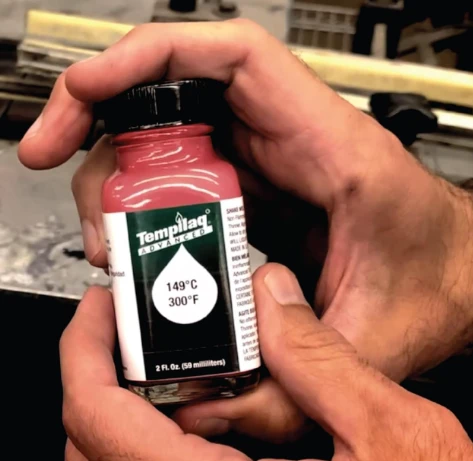
When to Use Tempilstik® — When to Use an IR Thermometer
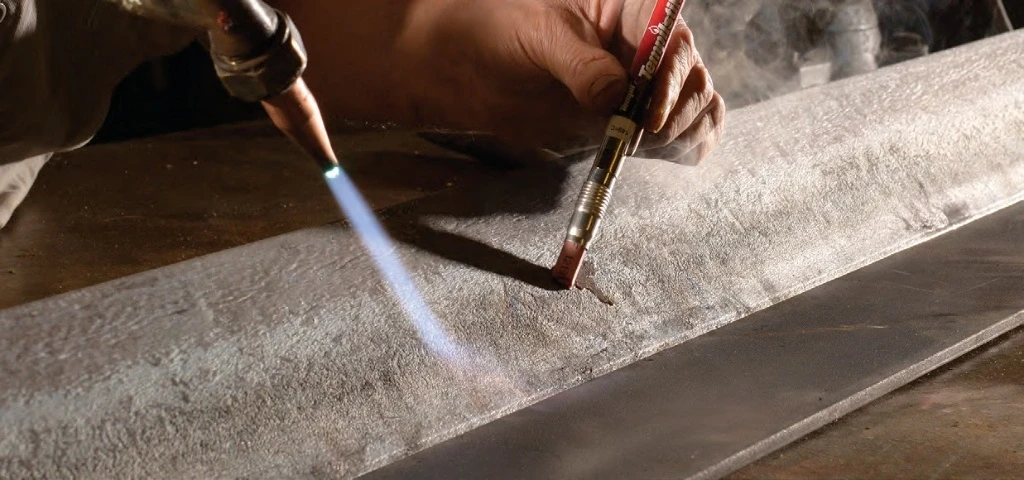
This is the primary application. Tempilstik® delivers an unambiguous, physically verifiable result confirming that a specific joint has reached the exact WPS-required temperature before the arc is struck. The melt mark is visible evidence that can be photographed and recorded in the QA/QC file without ambiguity. Reliable in outdoor conditions — wind, rain, uneven surfaces.
For steels with low or variable emissivity (blast-cleaned Cr-Mo, stainless steel), IR thermometer error can reach 20–40°C. For P91 with a mandatory minimum preheat of 200°C (392°F) where ±10°C means the difference between pass and fail, the risk of relying on an IR thermometer alone is unacceptable on a strictly-monitored project.
An IR thermometer is very useful for observing which parts of the heating zone are reaching temperature and which still need more heat input — before the definitive Tempilstik® check. Use the IR to guide heating, then Tempilstik® to confirm before welding.
For welds in narrow gaps, small-bore pipe below DN 50, or areas where personal safety prevents close approach, an IR thermometer may be the only practical option. In these cases, emissivity must be carefully corrected or emissivity tape applied to the measurement point to improve accuracy.
Conclusions — Choosing by Actual Field Conditions
- Steel surface has mill scale, rust, or primer coating
- Outdoor conditions — wind, rain, high humidity
- High-alloy steel: P11, P22, P91, duplex SS
- Visual, photographable QA/QC evidence is required
- No batteries available at the work location
- Absolute reliability is needed for each individual joint
- Third-party inspector is witnessing preheat sign-off
- Clean surface with accurately known emissivity
- Rapid scanning of multiple points in sequence
- Remote measurement — surface is inaccessible
- Controlled indoor fab shop environment
- Continuous furnace temperature monitoring
- Preliminary screening to guide heating operations
Frequently Asked Questions
Can an IR thermometer be accurately adjusted for steel emissivity in the field?
Technically yes — but to do so correctly requires knowing the exact emissivity for that specific surface condition at that temperature. The only reliable method is to place a thermocouple at the same point, heat the surface, and adjust the emissivity dial until both readings agree. This is too time-consuming for high-throughput preheat inspection on a construction site. On a surface that is half mill scale and half rust, the emissivity also varies across the measurement spot, adding a further uncertainty that cannot be corrected with a single ε setting.
Does AWS D1.1 permit infrared thermometers for preheat measurement?
AWS D1.1 does not prohibit IR thermometers but requires that temperature measurement devices be calibrated and accurate. The problem is that a device can be fully calibrated yet still give an inaccurate reading when the emissivity is set incorrectly — and the inspector has no way to detect this on site. Many owner QA procedures for O&G projects explicitly require temperature indicating crayons (sticks) for the final preheat pass/fail decision, precisely because of this limitation.
Can Tempilstik® be used for high-temperature PWHT checks above 600°C (1112°F)?
Yes — Tempilstik® is available up to 2000°F (1093°C). For carbon steel PWHT at 600–650°C (1112–1202°F) or P91 PWHT at 730–760°C (1346–1400°F), Tempilstik® remains accurate and is routinely used as a supplementary spot-check alongside thermocouple dataloggers — confirming that specific locations on the weld actually reached the required temperature rather than relying solely on thermocouple placement.
Need technical guidance on choosing the right preheat measurement tool for your project? Contact the Fast Group technical team — tempil.vn is the authorised Tempil® distributor in Vietnam, with over a decade of O&G welding support experience.
View Tempilstik® Part Numbers +84 938 888 958