Tempilstik® vs Thermomelt® — Detailed Comparison to Choose the Right Temperature Indicator
Tempilstik® and Thermomelt® are both solid-wax temperature indicating crayons from Tempil® (now part of Illinois Tool Works — ITW), Made in USA. Both work on the same principle: touch to a hot metal surface — if the crayon melts, that surface has reached the rated temperature. But they are not the same product: the body size differs, the application focus differs, and the level of national-standards traceability differs. Choosing the wrong one does not compromise technical accuracy, but it may cause practical inconvenience or fail to meet a project's documentation requirements.
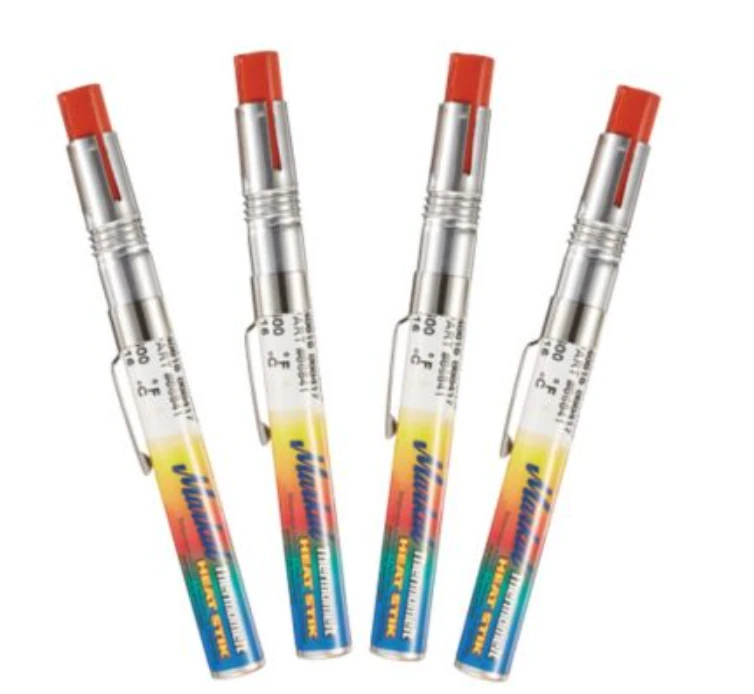
The Core Physical Difference: Body Size and Grip
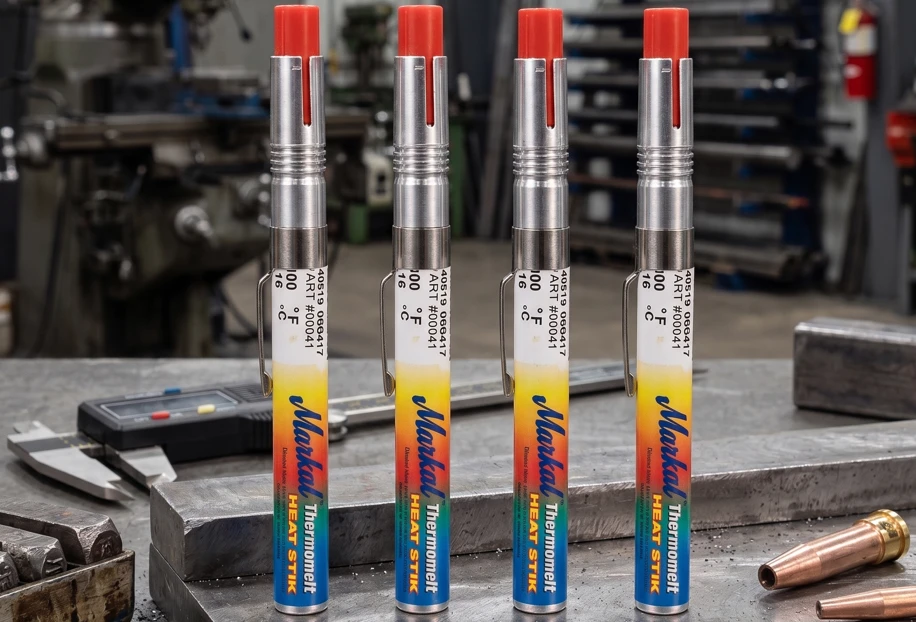
Thermomelt® is approximately 33% larger in volume than Tempilstik®. The thicker body is designed for use with heavy welding gloves — fingers wrapped in thick material are less able to control a slender object. During wide-area PWHT operations (heating an entire pipe spool or large plate assembly), the operator often stands back and reaches into the heated zone; the larger body of Thermomelt® reduces the risk of it slipping from a gloved hand.
Tempilstik® is slimmer and lighter, well suited for spot-checking at a precise point and working in confined spaces — gaps between pipe runs, structural corners, hard-to-reach locations. This is why Tempilstik® is the dominant product for daily preheat checks on construction sites: compact, pocket-sized, and manageable with one hand.
NIST Traceability — When This Matters
This is the most important documentation difference between the two products. Thermomelt® is NIST-traceable — meaning its accuracy is traceable to the US National Institute of Standards and Technology. Each box of Thermomelt® comes with a Certificate of Conformance (C/C) bearing the production lot number and a traceability statement linking it to NIST measurement standards.
This does not mean Tempilstik® is less accurate — both products meet the same tolerance of ±1%°F / ±3%°C. The difference is documentation, not physics. For projects requiring NIST-traceable documentation under contract terms — nuclear, defence, aerospace, or any project where the contract specification explicitly requires NIST-traceable temperature indicating devices — Thermomelt® satisfies that requirement while Tempilstik® does not.
For the vast majority of O&G, offshore structural, and power-plant projects in Vietnam operating under AWS D1.1, ASME B31.1/B31.3, or EN 1011-2, Tempilstik® is fully compliant and there is no requirement — or justification — for paying the premium associated with NIST-traceable documentation.
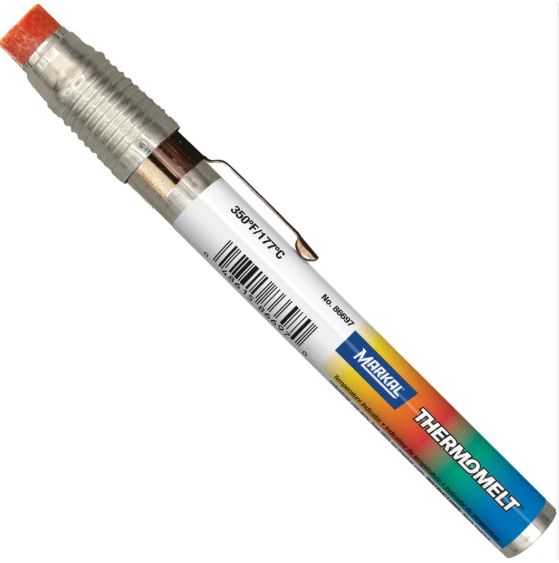
Thermomelt® — multiple grades
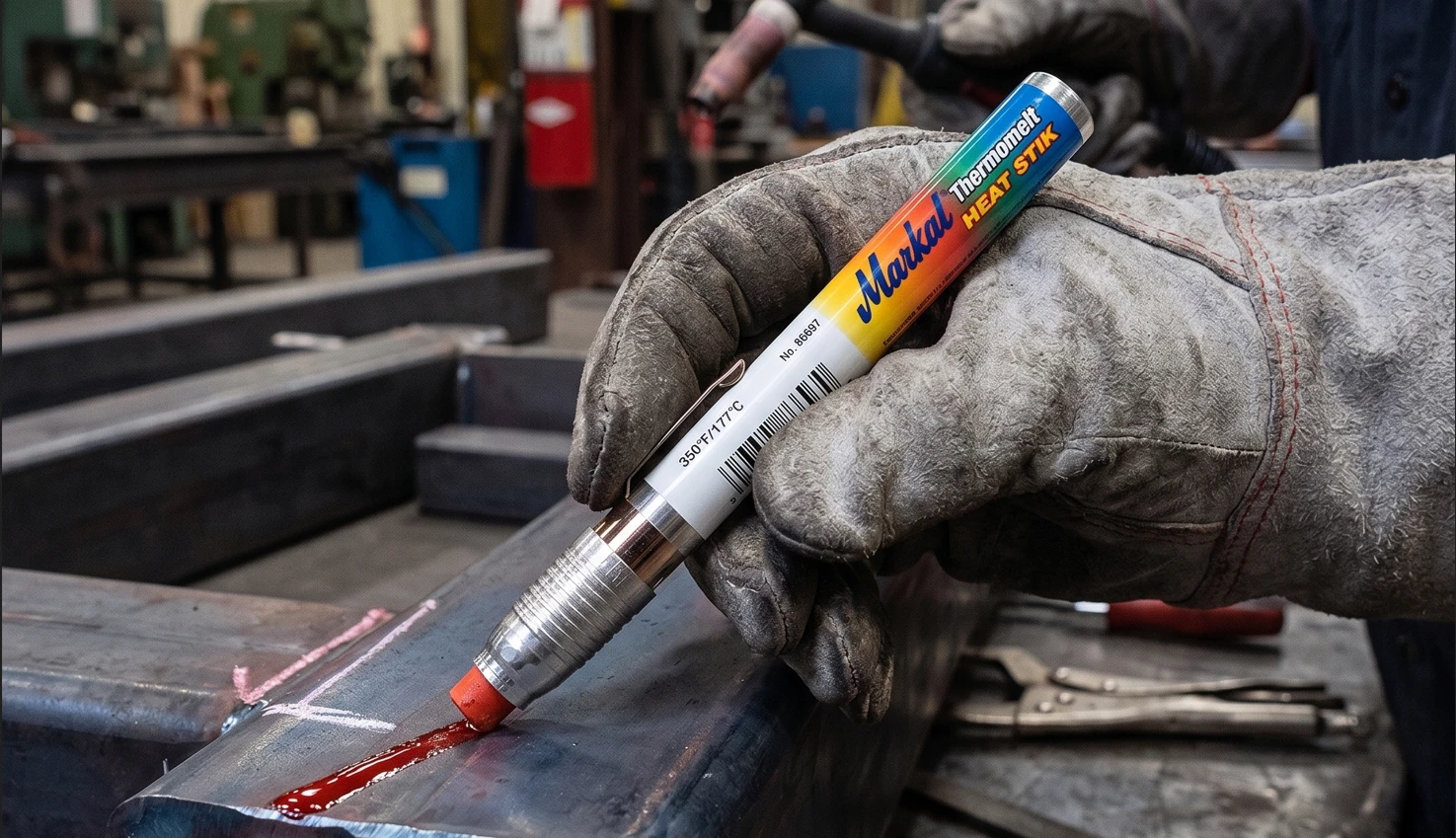
Heatstik® for furnace/PWHT
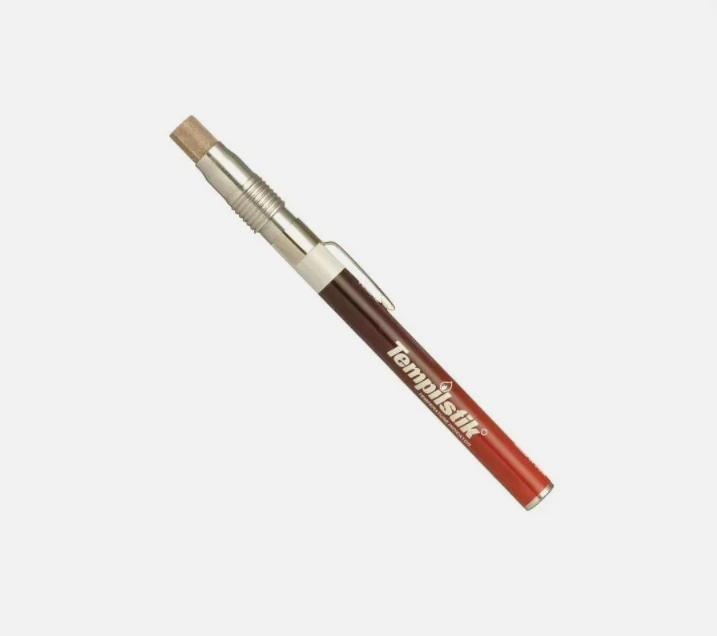
Tempilstik® compact
10-Criterion Comparison Table
| Criterion | Tempilstik® | Thermomelt® |
|---|---|---|
| Body / size | Slim — comparable to a large pencil | ~33% larger body — thicker grip for heavy gloves |
| Accuracy tolerance | ±1%°F / ±3%°C | ±1%°F / ±3%°C |
| NIST-traceable | No | Yes — lot-specific C/C included |
| Lead-free / sulfur-free | Yes (since 2012) | Yes |
| Part number series | 28xxx | 86xxx |
| Typical applications | Preheat, interpass, electrode oven verification | Wide-area PWHT, nuclear, defence, aerospace |
| Use with heavy welding gloves | More difficult — slim body can slip | Easier — thick body provides secure grip |
| Spot-check efficiency | Good — less material consumed per check | Less efficient — larger body consumed per mark |
| Applicable standards | AWS D1.1, ASME I/III/VIII, B31.1, B31.3, API 1104, EN 1011-2 | AWS D1.1, ASME I/III/VIII, B31.1, B31.3, plus nuclear/defence specs |
| Price / cost | Lower unit cost | Higher (NIST-traceable documentation premium) |
Cross-Reference: Equivalent Part Numbers
Thermomelt® and Tempilstik® share ratings at many temperature levels. The table below lists the most commonly used equivalent pairs in welding and heat-treatment applications:
| Temperature | Tempilstik® Part No. | Thermomelt® Part No. | Common Application |
|---|---|---|---|
| 121°C / 250°F | #28019 | #86562 | E7018 electrode oven verification |
| 150°C / 302°F | #28318 | — | Max interpass duplex SS, P11 preheat |
| 177°C / 350°F | #28031 | #89350 | Low-temperature stress relief range |
| 200°C / 392°F | #28327 | — | P22 and P91 minimum preheat |
| 260°C / 500°F | #28043 | #89500 | Intermediate stress relief range |
| 316°C / 600°F | #28047 | #86841 | PWHT spot-check for carbon steel |
| 427°C / 800°F | #28051 | #89400 (204°C / 400°F) | PWHT P91 — lower bound confirmation |
Conclusion: Which Product for Which Situation
The decision rests on three factors: the project's documentation requirements, the physical conditions of use, and the specific temperature range needed.
Use Tempilstik® when:
- Daily preheat verification per AWS D1.1 or ASME B31.1/B31.3
- Interpass temperature checks between weld passes
- Electrode oven temperature verification for E7016/E7018 rods
- Precise spot-checking in confined spaces, multiple checks per shift
- Commercial, industrial, and offshore projects — no NIST-traceable documentation required by contract
Use Thermomelt® when:
- Contract or client specification explicitly requires NIST-traceable documentation
- Wide-area PWHT with operators wearing heavy duty welding gloves
- Nuclear, defence, or aerospace projects where national standards traceability is mandatory
- Lot-specific Certificate of Conformance is required for the third-party inspector's QA package
Frequently Asked Questions
Is Thermomelt® more accurate than Tempilstik®?
No. Both products meet the same tolerance of ±1%°F / ±3%°C — identical physical measurement precision. The difference is that Thermomelt® carries NIST-traceable documentation, not that it measures temperature more accurately at the molecular level. Choosing Thermomelt® where NIST traceability is not required by the contract adds cost without any technical benefit.
Does my ASME Section VIII project require Thermomelt®?
ASME Section VIII does not mandate NIST traceability for hand-held temperature indicating crayons. Tempilstik® is fully recognised under ASME Code. Thermomelt® is only required when the purchase order, client specification, or quality plan explicitly states "NIST-traceable temperature indicating device" as a contractual requirement.
Can Tempilstik® and Thermomelt® be used for the same temperature?
Yes, at many overlapping ratings. For example, Tempilstik® #28019 (250°F / 121°C) and Thermomelt® #86562 (250°F / 121°C) produce identical pass/fail results. However, not every Tempilstik® rating has a Thermomelt® equivalent — some critical ratings such as 200°C / 392°F (#28327 — P91 minimum preheat) exist only in the Tempilstik® series.
Is Thermomelt® available in Vietnam?
Yes. Fast Group (tempil.vn) is the authorised Tempil® distributor in Vietnam and stocks both Tempilstik® and Thermomelt® with original C/O (Certificate of Origin) and C/Q (Certificate of Quality) from the manufacturer. Contact us for current stock availability and lead time on specific 86xxx series grades.
Does Tempilstik® require periodic calibration?
No. Wax-based temperature indicating crayons do not require periodic calibration — unlike thermocouples or IR thermometers. The melting-point chemistry is inherently stable. Simply store in a sealed container, protected from ambient temperatures above 30–35°C (86–95°F), avoid physical impact that could crack the wax body, and use before the expiry date printed on the box. For full usage guidance see What Is Tempilstik® — Usage Guide.
Need help deciding between Tempilstik® and Thermomelt® for your project? Fast Group (tempil.vn) is the authorised Tempil® distributor in Vietnam — C/O, C/Q, and VAT invoice. Individual sticks and boxes of 10 available for both series.
Request a Quote +84 938 888 958