Tempilstik® in Power Plant Welding: Temperature Control from P91 Preheat to PWHT
Thermal power plants represent the most demanding welding environment for temperature control. Main steam lines, hot reheat lines, and headers operate continuously at 540–600°C (1004–1112°F) under pressures of 16–31 MPa (2,320–4,500 psi) — any weld deficiency is a top-tier industrial safety risk. P91 steel (9Cr-1Mo-V, ASME SA-335 Grade P91) is specified precisely because of its long-term creep resistance at elevated temperature, but its distinctive metallurgy also makes it the most demanding piping material to weld correctly in field conditions.
This article covers the complete temperature-control sequence for welding and PWHT at a thermal power plant — from preheat before striking the arc, through interpass control between weld passes, to mandatory post-weld heat treatment — with specific Tempilstik® part numbers and practical field guidance.
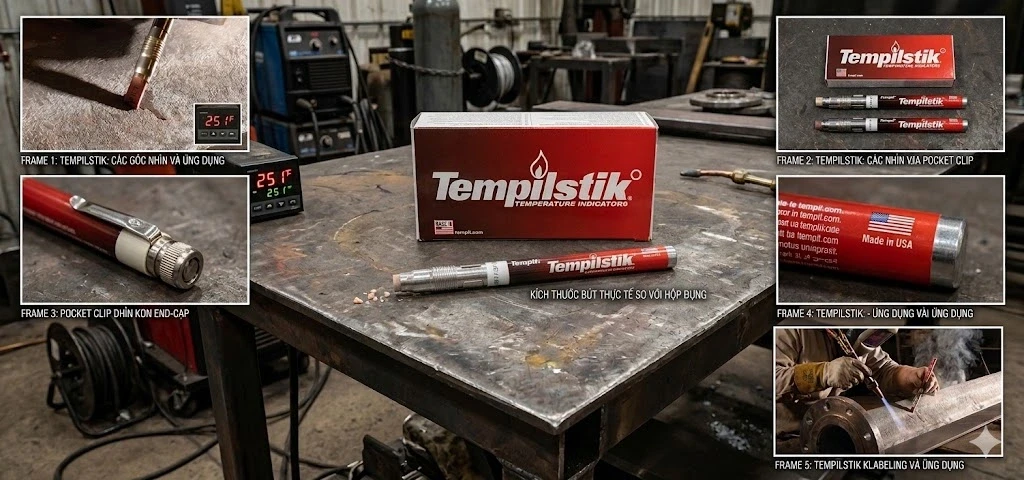
Power Plant Piping Systems — Welding Temperature Overview
A thermal power plant encompasses several operating temperature zones, each with distinct materials and welding requirements:
| System / Line | Operating Temperature | Pressure (MPa) | Typical Material | ASME P-Number | Min. Preheat |
|---|---|---|---|---|---|
| Main steam line | 540–600°C (1004–1112°F) | 16–31 | P91, P92 | P-No.5B | 200°C (392°F) |
| Hot reheat line | 550–570°C (1022–1058°F) | 3–5 | P91, P11 | P-No.4/5B | 150–200°C (302–392°F) |
| HP header | 500–560°C (932–1040°F) | 16–25 | P91, P22 | P-No.5A/5B | 200°C (392°F) |
| HP boiler feed water (BFW) | 130–220°C (266–428°F) | 20–30 | A106 Gr.B, P11 | P-No.1/4 | 79–150°C (175–302°F) |
| Condensate / LP steam drain | < 200°C (392°F) | < 1 | A106 Gr.B | P-No.1 | 66–79°C (150–175°F) |
| Cooling water system | < 60°C (140°F) | < 0.5 | Carbon steel, SS | P-No.1/8 | 10–66°C or not required |
In practice, welding engineers and QA/QC personnel on a power-plant site must manage multiple material types and preheat requirements simultaneously on the same jobsite. The most common mistake is applying a single preheat temperature to all piping — adequate for carbon steel but entirely insufficient for P91.
P91 Main Steam Piping — Detailed Temperature Control Sequence
Main steam piping in P91 is the most demanding application for welding temperature control and the area where Tempilstik® sees the heaviest use in a power-plant welding programme. The following covers the four-stage sequence for a P91-to-P91 weld per ASME B31.1.
Typical joint parameters
Material: ASME SA-335 P91 (9Cr-1Mo-V) — P-Number 5B
Typical dimensions: DN 300–500 mm (12"–20"), wall thickness 30–60 mm (1.2"–2.4")
Welding process: GTAW root pass + SMAW or SAW fill and cap
Filler metal: ER90S-B9 (GTAW), E90xx-B9 (SMAW) — must match base metal Cr-Mo content
Applicable code: ASME B31.1, ASME Section IX, WPS approved by Authorised Inspector (AI)
Stage 1: Preheat — Tempilstik® #28327 (200°C / 392°F)
ASME B31.1 Table 132.1 requires a minimum preheat of 200°C (392°F) for P-No.5B (which includes P91). The purpose goes beyond simple hydrogen cold-crack prevention — preheat controls the HAZ cooling rate to ensure uniform martensite formation before PWHT. For the metallurgical background see P91 Steel Welding — Preheat 200°C and Mandatory PWHT.
Field preheat procedure for power-plant P91 piping:
- Apply electric resistance heating mats around the pipe, extending the heated zone at least 75 mm (3") either side of the bevel face
- Allow thermal soak — for 50 mm (2") wall thickness, allow at least 45–60 minutes after the thermocouple records 200°C at the surface
- Touch Tempilstik® #28327 (392°F / 200°C) to the pipe surface at 4–6 points around the circumference, 75 mm (3") from the bevel edge
- Check additionally at the bottom of the pipe (6-o'clock position) — this point tends to run cooler because convection heat does not reach it
- Begin welding only when all check points show the crayon melting (confirming ≥200°C)
- Record in the Preheat Log: time, check points, results, inspector name, WPS number
Stage 2: Interpass Temperature — Tempilstik® #28053 (482°C / 900°F)
After the first (root) pass with GTAW, the weld zone temperature rises significantly. P91 requires a maximum interpass temperature of ≤300°C (572°F). Exceeding this limit coarsens austenite grains in the coarse-grain HAZ (CG-HAZ), reduces Charpy impact toughness, and creates conditions for premature creep failure during service. For a full explanation see Interpass Temperature — Control Between Weld Passes.
Interpass check procedure using Tempilstik® #28053:
- Before starting each subsequent pass, touch the crayon to the weld zone surface (not the just-deposited weld bead itself)
- If the crayon melts immediately — temperature has exceeded 300°C; stop and allow the joint to cool before depositing the next pass
- If the crayon does not melt — temperature is below 300°C; proceed (provided the joint is still ≥200°C preheat)
- Check consistently throughout the weld — heat accumulates rapidly during multiple SMAW passes

Stage 3: Cool-Down Before PWHT — confirmed with Tempilstik® #28327
This is a technical point that inexperienced P91 welders often misunderstand. After welding is complete, the joint must be allowed to cool to below 200°C (392°F) before it is transferred to the PWHT furnace — the joint should not be held at welding temperature continuously. The reason: the martensite finish temperature (Mf) for P91 is approximately 200°C. If PWHT begins while the joint is still above Mf, austenite has not fully transformed to martensite and PWHT will not achieve its intended stress-relief and tempering effect.
Use Tempilstik® #28327 (200°C / 392°F) to confirm the joint has cooled sufficiently: when the crayon does not melt on contact — the joint is below 200°C and ready for PWHT.
Stage 4: PWHT — Spot-Check with Tempilstik® #28065 (788°C / 1450°F)
PWHT for P91 per ASME B31.1 Table 132 is performed in the range 730–760°C (1346–1400°F). The primary instruments are thermocouples attached directly to the pipe and a continuous datalogger — this temperature–time chart is the mandatory formal PWHT record.
Tempilstik® fills the supplementary spot-check role at points not covered by thermocouples:
- Part #28065 (1450°F / 788°C) — confirms the surface at that specific point has exceeded the lower bound of the PWHT range. Crayon melts at a given location = that location has reached ≥788°C. Used for spot-checking uniform heat distribution along long seam welds or at branch connections where thermocouple coverage is limited.
- Part #28047 (600°F / 316°C) — applied during the heat-up phase to confirm the surface has passed 316°C before continuing to PWHT temperature. Helps identify uneven heating zones early in the cycle.
For full PWHT guidance see PWHT — Post-Weld Heat Treatment and Temperature Control.
P11 and P22 Piping — Intermediate Zone Temperature Control
Beyond the main steam P91 piping, a typical power plant also uses P11 (1.25Cr-0.5Mo) and P22 (2.25Cr-1Mo) for hot reheat and intermediate headers. Both require less stringent control than P91 but significantly more than plain carbon steel:
| Material | P-Number | Min. Preheat | Max. Interpass | PWHT | Tempilstik® — Preheat | Tempilstik® — Interpass |
|---|---|---|---|---|---|---|
| A335 P11 (1.25Cr-0.5Mo) | P-No.4 | 150°C / 302°F | ≤ 250°C (482°F) | 675–760°C, mandatory | #28318 | #28039 (232°C / 450°F) |
| A335 P22 (2.25Cr-1Mo) | P-No.5A | 200°C / 392°F | ≤ 300°C (572°F) | 675–760°C, mandatory | #28327 | #28053 (482°C / 900°F) |
| A335 P91 (9Cr-1Mo-V) | P-No.5B | 200°C / 392°F | ≤ 300°C (572°F) | 730–760°C, mandatory | #28327 | #28053 (482°C / 900°F) |
| A106 Gr.B (carbon steel) | P-No.1 | 79°C / 175°F (t ≥ 25 mm) | ≤ 260°C (500°F) | 595–650°C (t > 19 mm) | #28009 | #28039 (232°C / 450°F) |
Complete Tempilstik® Part-Number Reference for Power Plant Projects
The table below consolidates all Tempilstik® grades used across the full welding and PWHT cycle at a thermal power plant — from the lowest-class carbon steel to P91:
| Part No. | Temperature | Application at Power Plant | Material | Stage |
|---|---|---|---|---|
| #28006 | 66°C / 150°F | Preheat thin-wall carbon steel (< 25 mm) | A106 Gr.B, thin SS400 | Preheat |
| #28009 | 79°C / 175°F | Preheat P-No.1 heavy wall (t ≥ 25 mm) — BFW piping | A106 Gr.B, A53 | Preheat |
| #28019 | 121°C / 250°F | Electrode oven verification; preheat P-No.1 very heavy wall (> 40 mm) | A106 Gr.B heavy, A105 | Preheat / Electrode oven |
| #28312 | 110°C / 230°F | Electrode oven check — E7018 lower bound | — | Electrode oven |
| #28318 | 150°C / 302°F | Preheat P11; electrode oven upper bound; interpass limit P11 | A335 P11, A213 T11 | Preheat / Interpass / Electrode oven |
| #28327 | 200°C / 392°F | Preheat P91 and P22 (minimum required) — most-used grade in power-plant welding | A335 P91, P22, P9 | Preheat / Cool-down confirmation before PWHT |
| #28039 | 232°C / 450°F | Maximum interpass for carbon steel; upper-bound interpass check for P11 | A106 Gr.B heavy, P11 | Interpass |
| #28053 | 482°C / 900°F | Maximum interpass for P91 and P22 — mandatory check before each weld pass | A335 P91, P22 | Interpass |
| #28047 | 316°C / 600°F | PWHT spot-check for carbon steel; heat-up phase verification during P91 PWHT | A106, P11, P22 | PWHT spot-check |
| #28057 | 371°C / 700°F | PWHT spot-check for P11 and P22 | A335 P11, P22 | PWHT spot-check |
| #28065 | 788°C / 1450°F | PWHT spot-check for P91 — confirms surface has reached the lower bound of the tempering range | A335 P91 | PWHT spot-check |
All part numbers above are stocked at tempil.vn/en/tempilstik/ — the authorised Tempil® (LACO Industries, Made in USA) distributor in Vietnam, with original C/O, C/Q, and VAT invoice.
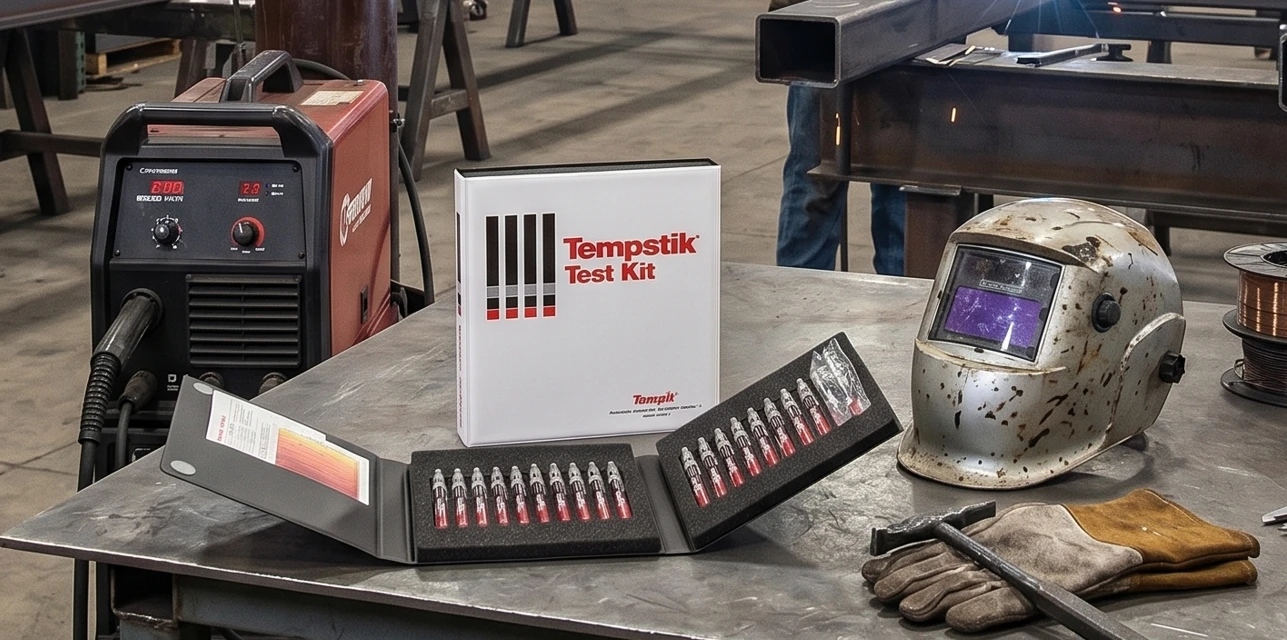
Site Practices for Power-Plant Welding Programmes
Temperature control organisation within a welding shift
On large power-plant projects — including coal-fired and gas-fired plants with multiple boiler units — temperature control is typically organised by role:
- Welding Inspector (IWI/CWI): responsible for confirming preheat with Tempilstik® before each joint is started, signing the Preheat Record. No welding may begin without the inspector's signature.
- Welder: self-checks interpass temperature between passes using Tempilstik® #28053 — stops when the crayon melts; no need to call the inspector for each interpass check.
- PWHT Operator: operates the resistance heating system and thermocouple datalogger; inspector uses Tempilstik® #28065 to spot-check at 3–5 points around the joint, confirming uniform heat distribution.
- QA/QC Engineer: reviews and archives all records — Preheat Log, Interpass Log, PWHT Chart (thermocouple trace), PWHT Spot-Check Record.
Storage of Tempilstik® on power-plant sites
Site conditions at thermal power plants in Vietnam (ambient 30–40°C, high humidity) place specific demands on crayon storage:
- Store in a sealed container away from direct sunlight and ambient temperatures above 35°C (95°F)
- Do not leave crayons in a vehicle or metal container in direct sun — interior temperatures can reach 60–70°C, causing slight deformation of the crayon body
- Crayons that are slightly bent or deformed still give accurate results — only discard crayons with cracks or fractures through the wax body
- Each box of 10 carries an expiry date — use before expiry on a FIFO (first-in, first-out) basis
- Order sufficient quantity for the full project at the start to avoid mid-project supply gaps — tempil.vn delivers to project sites in Vung Tau, Can Tho, Ha Noi, Quang Ninh, and nationwide
Frequently Asked Questions
Why must P91 be preheated to 200°C (392°F) rather than 150°C (302°F) like P11?
P91 has significantly higher chromium (9% vs 1.25% in P11) and contains vanadium, both of which greatly increase hardenability. The higher Carbon Equivalent of P91 makes the HAZ considerably more prone to forming brittle martensite on rapid cooling. Preheat at 200°C for P91 not only prevents hydrogen cold cracking but controls the martensite microstructure forming in the HAZ — a prerequisite for PWHT to achieve its intended tempering effect. P11 is less hardenable, so 150°C is sufficient.
Can Tempilstik® fully replace thermocouples during PWHT of P91 piping?
No. Thermocouples with a datalogger are the primary measurement instrument, producing a continuous temperature–time chart that is a mandatory record under ASME and third-party inspection requirements. Tempilstik® is a supplementary spot-check tool — confirming temperature at specific points not covered by thermocouple placement. Both must be used simultaneously. This is especially important for P91, which has the strictest PWHT requirements of all common piping materials.
For a P91-to-P22 dissimilar weld, what preheat applies?
Apply the preheat of the more demanding material — 200°C (392°F) for P91 — using Tempilstik® #28327. This is the standard conservative rule in ASME for dissimilar-metal joints. Filler metal selection for P91/P22 dissimilar joints (typically E90xx-B9 or per WPS guidance) should be confirmed with the welding engineer before welding begins.
A foreign contractor requires NIST-traceable temperature measurement — which product should be used?
If the contract requires NIST-traceable documentation, use Thermomelt® (series 86xxx) rather than Tempilstik® for PWHT monitoring. Thermomelt® 86xxx carries a Certificate of Conformance traceable to NIST — meeting the QA documentation requirements of nuclear and certain international power-plant contracts. Tempilstik® remains appropriate for preheat and interpass checks, as NIST-traceability requirements typically apply to PWHT measurement instruments, not preheat spot-check tools. Contact tempil.vn for specific contract-requirement guidance.
Do I need a full set of part numbers or just a few?
Depends on scope. For a project covering the full range from carbon-steel utility piping through P91 main steam, the minimum kit is: #28009 (preheat P-No.1 heavy wall), #28327 (preheat P91/P22), #28053 (interpass P91), #28065 (PWHT spot-check P91), and #28312/#28318 (electrode oven verification). If scope is limited to carbon-steel piping only, #28006 or #28009 may be sufficient. Contact tempil.vn for a recommendation matched to your scope of work.
Need Tempilstik® for a power-plant project? Fast Group (tempil.vn) is the authorised Tempil® (LACO Industries, Made in USA) distributor in Vietnam — genuine product with original C/O, C/Q, and VAT invoice. Delivery to project sites in Vung Tau, Can Tho, Ha Noi, Quang Ninh, and nationwide.
Request a Quote +84 938 888 958