Preheat Temperature for Carbon Steel Welding — Complete Guide per AWS D1.1 & ASME
Skipping preheat when welding carbon steel can cause hydrogen-induced cold cracking — a metallurgical defect that is not visible immediately after welding but causes joint failure or accelerated degradation over time. In pressure vessel fabrication, pipeline construction, and heavy industrial structures, preheat is a mandatory technical requirement defined by specific parameters in the approved WPS.
What is Preheat and Why is it Mandatory?
Preheat is the process of heating the base metal surrounding the weld zone to a specified minimum temperature before striking the arc. It is a direct intervention in the metallurgical behavior of the heat-affected zone (HAZ) — not an optional precaution.
| Technical Purpose | Mechanism |
|---|---|
| Prevents hydrogen-induced cold cracking (HIC) | Removes surface moisture and slows cooling — eliminating the primary hydrogen source that diffuses into the weld pool and causes HAZ cracking |
| Reduces HAZ cooling rate | Higher base temperature slows post-weld cooling, preventing brittle martensite formation in the HAZ and maintaining joint toughness |
| Promotes hydrogen diffusion | Slower cooling gives residual hydrogen sufficient time to diffuse out of the weld metal before solidification is complete |
| Reduces residual stress and distortion | Reducing the thermal gradient between the weld pool and the surrounding base metal limits shrinkage and warping |
AWS D1.1 Preheat Table — Quick Lookup
AWS D1.1 (Structural Welding Code — Steel) is widely applied in Vietnam for bridges, industrial buildings, and steel structures. Minimum preheat temperature depends on material thickness and Carbon Equivalent (CE).
| Steel Category (AWS D1.1) | Carbon Equivalent (CE) | t ≤ 20 mm | t 20–38 mm | t 38–65 mm | t > 65 mm | Tempilstik® Part No. |
|---|---|---|---|---|---|---|
| Category I SS400, A36, SM400 |
CE ≤ 0.40 | Not required* | Not required* | 66°C (150°F) | 110°C (230°F) | #28006 / #28312 |
| Category II SM490, A572 Gr.50 |
CE 0.41–0.45 | Not required* | 66°C (150°F) | 110°C (230°F) | 150°C (302°F) | #28006 / #28312 / #28318 |
| Category III SM520, A572 Gr.65 |
CE 0.46–0.60 | 66°C (150°F) | 110°C (230°F) | 150°C (302°F) | 200°C (392°F) | #28006 / #28312 / #28318 / #28327 |
| Category IV HY-80 and equivalent |
CE > 0.60 | 110°C (230°F) | 150°C (302°F) | 200°C (392°F) | 230°C (446°F) | #28312 / #28318 / #28327 / #28332 |
* Not required per standard — preheat to minimum 10°C recommended when ambient temperature is below 5°C.
CE formula (IIW): CE = C + Mn/6 + (Cr+Mo+V)/5 + (Ni+Cu)/15. Obtain values from the steel Mill Test Certificate.
ASME B31.3 Preheat Table — Process Piping
ASME B31.3 applies to process piping systems in power plants, refineries, and chemical facilities. Unlike AWS, ASME classifies materials by P-Number — found in the approved WPS or the pipe Mill Certificate.
| P-Number (ASME B31.3) | Typical Steel | Wall < 25 mm | Wall ≥ 25 mm | Tempilstik® Part No. |
|---|---|---|---|---|
| P-No.1 (Gr.1,2,3) | Carbon steel: A106 Gr.B, A53, A333 Gr.6 | 10°C (50°F) | 79°C (175°F) | #28009 |
| P-No.1 (Gr.4,5) | High-carbon steel: A106 Gr.C | 79°C (175°F) | 79°C (175°F) | #28009 |
| P-No.3 | Alloy steel: A335 P1, A335 P2 | 79°C (175°F) | 79°C (175°F) | #28009 |
| P-No.4 | 1.25Cr–0.5Mo: A335 P11, P12 | 150°C (302°F) | 150°C (302°F) | #28318 |
| P-No.5A | 2.25Cr–1Mo: A335 P22 | 200°C (392°F) | 200°C (392°F) | #28327 |
| P-No.15E (P91) | 9Cr–1Mo-V: A335 P91 | 200°C (392°F) | 200°C (392°F) | #28327 — PWHT mandatory |
For P91 full requirements see: P91 Steel Welding — Preheat 200°C & Mandatory PWHT.
For complete P-Number guide see: ASME B31.3 Preheat — Process Piping.
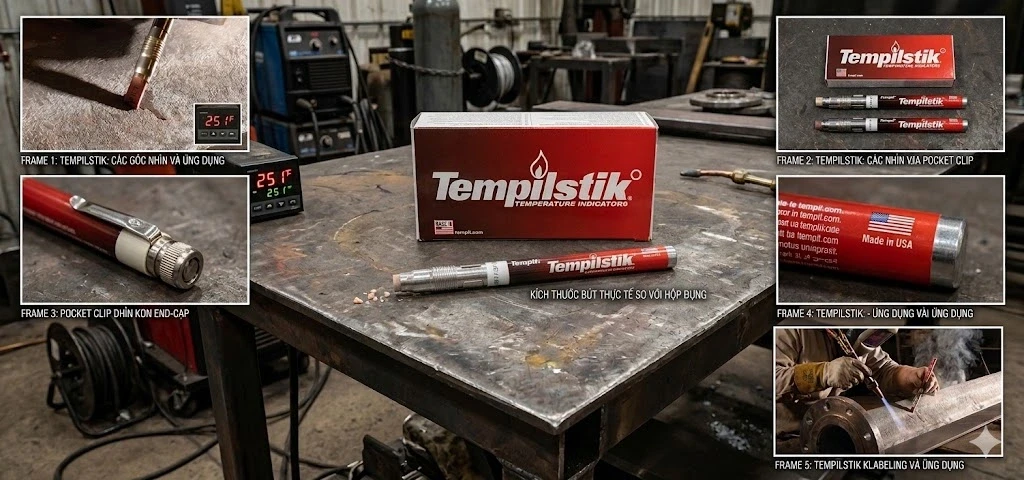
Field Verification with Tempilstik®
Infrared thermometers (IR guns) frequently give erroneous readings on heated steel surfaces because the emissivity coefficient changes continuously with temperature — compounded by the effects of mill scale, rust, and weld spatter. The physical crayon method provides significantly higher reliability in field conditions.
Tempilstik® operates on a simple principle: mark the crayon on the steel surface — if it melts immediately to a clear liquid, the surface has reached or exceeded that rated temperature. If the chalk-like mark stays solid, that zone has not yet reached the required temperature. No calibration required. No emissivity errors. Instant result.
| Preheat Minimum | Tempilstik® Part No. | Typical Application |
|---|---|---|
| 66°C / 150°F | #28006 | AWS Cat. I structural steel — best-selling SKU in Vietnam |
| 79°C / 175°F | #28009 | ASME P-No.1 pipe wall ≥ 25 mm (A106 Gr.B) |
| 110°C / 230°F | #28312 | AWS Cat. I heavy section, Cat. II–III thick plate |
| 150°C / 302°F | #28318 | AWS Cat. III–IV, ASME P-No.4 (P11) |
| 200°C / 392°F | #28327 | ASME P-No.5A (P22), P91 — mandatory minimum |
Tempilstik® (Made in USA) meets ±1% Fahrenheit (±3% Celsius) accuracy and is recognized by AWS D1.1, ASME Section I, III, VIII, B31.1, and B31.3 as a valid direct-contact temperature measurement method. Full 116-SKU range: Tempilstik® product page.
Common Field Mistakes
Frequently Asked Questions
Need Tempilstik® for carbon steel preheat verification?
Fast Group Engineering — authorized Tempil® distributor in Vietnam. C/O + C/Q + VAT invoice. Stock in HCMC and Vung Tau.
📞 +84 938 888 958 | ✉ sales@tempil.vn